
How to Increase Business Credit Fast (2026 Guide)
Learn how to increase business credit fast with proven steps. Build your score, get approved for funding, and grow your business the right way in 2026.
BUSINESS CREDIT
Russel
6/4/20268 min read
The Business Credit Problem Nobody Talks About
You work hard. You run a real business. But when you apply for funding, the lender looks at your business credit — and there's almost nothing there.
This is more common than you think.
Most small business owners in the US don't realize their business has a separate credit profile from their personal credit. And if that business credit profile is thin, weak, or non-existent — getting approved for funding is really hard.
The good news? You can fix this.
This guide shows you exactly how to increase business credit fast, step by step. Whether you're starting from scratch or trying to improve a weak profile, these strategies work in 2026.
What Is Business Credit and Why Does It Matter?
Business credit is a score that lenders, suppliers, and financial institutions use to evaluate your company's creditworthiness. It's separate from your personal credit score.
Think of it like this: your business has its own financial reputation. The stronger that reputation, the easier it is to:
Get approved for business loans
Access higher credit limits
Qualify for net-30 vendor accounts (where you buy now and pay in 30 days)
Secure working capital without pledging personal assets
Build trade lines that support long-term growth
The three main business credit bureaus in the US are Dun & Bradstreet, Experian Business, and Equifax Business. Each scores your business differently, but they all look at similar factors — payment history, credit utilization, company age, and the number of trade accounts reporting.
When you increase your business credit score, lenders start to trust your company. And that trust turns into funding.
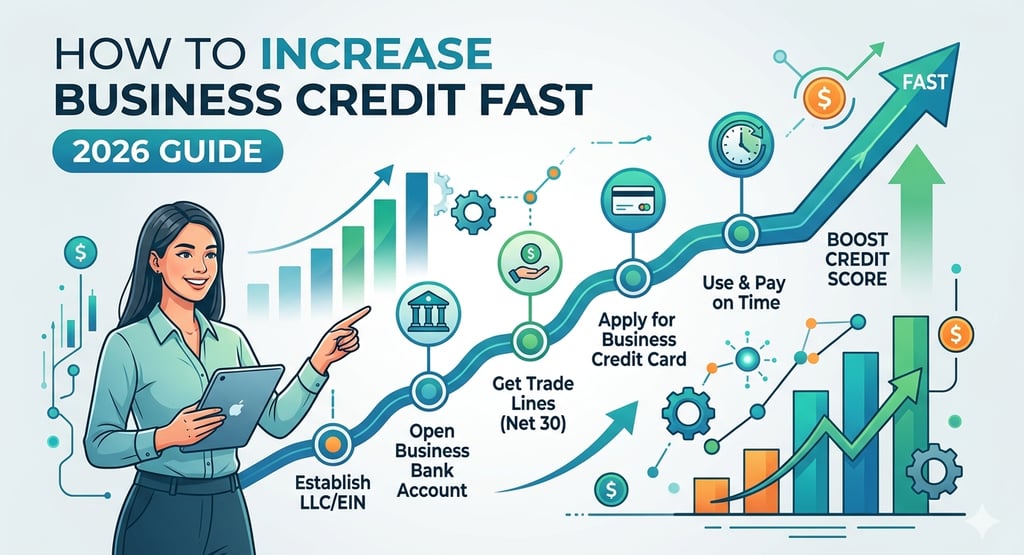
Step 1: Set Up Your Business the Right Way
Before you can build business credit, your business needs to be properly structured. This is where many owners skip steps — and it costs them later.
Here's what you need to have in place:
Register Your Business Entity
Your business should be registered as an LLC, corporation, or other formal entity. A sole proprietorship doesn't give your business its own legal identity, which makes it much harder to build separate business credit.
An LLC is usually the most practical choice for small business owners. It separates your personal and business finances, which is exactly what lenders want to see.
Get an EIN (Employer Identification Number)
An EIN is like a Social Security Number for your business. You apply for it through the IRS — and it's free.
Your EIN is how lenders and credit bureaus identify your business. Without it, you can't open a business bank account, apply for credit under your business name, or get your business credit profile started properly.
Open a Business Bank Account
This one step shows lenders that your business is real and financially active. Use your EIN and legal business name to open the account.
Try to maintain a consistent balance and keep your business transactions separate from personal spending. Lenders review bank statements before approving many loans and credit lines.
Get a Business Phone Number and Address
Your business should have a dedicated phone number listed in national directories. Many lenders verify basic business information through 411 or business listing databases.
Use a real business address — not a P.O. box. If you work from home, using a registered agent address is a practical solution.
Step 2: Get a D-U-N-S Number from Dun & Bradstreet
Dun & Bradstreet (D&B) is one of the most important business credit bureaus, especially for B2B vendors and larger lenders.
To get a profile with D&B, you need a D-U-N-S Number. It's free to apply and takes a few business days.
Once you have your D-U-N-S Number, your business has a file with D&B. From there, every vendor that reports your payment history to D&B will help build your Paydex score — which is D&B's version of a business credit score.
A Paydex score of 80 or above is considered good. Paying vendors early or on time consistently is the fastest way to reach it.
Step 3: Open Vendor Accounts That Report to Business Credit Bureaus
This is where your business credit score actually starts to grow.
Trade accounts — also called net-30 vendor accounts — let you buy products or services from a vendor and pay within 30 days. When those vendors report your payment history to the business credit bureaus, it builds your credit profile.
The key is to work with vendors that actually report to D&B, Experian Business, or Equifax Business. Not all vendors do this.
Some beginner-friendly vendors that often report to business credit bureaus include:
Uline (shipping and packaging supplies)
Grainger (industrial supplies)
Quill (office supplies)
Crown Office Supplies
Summa Office Supplies
Start with 3 to 5 of these accounts. Place small orders, pay on time (or early), and let the reporting do the work.
Within 60 to 90 days, you should start seeing accounts appear on your business credit reports.
Step 4: Apply for a Business Credit Card
Once you have a few vendor accounts reporting, the next step is to get a business credit card.
A business credit card used responsibly can significantly boost your business credit score. It adds a revolving credit account to your profile — which credit bureaus look at favorably.
Here's how to use it right:
Use the card for regular business expenses (supplies, software subscriptions, fuel)
Keep your credit utilization below 30% (this means don't use more than 30% of your available limit at a time)
Pay the balance in full every month, or at minimum pay on time
Credit utilization is simply how much of your available credit you're actually using. If your card has a $5,000 limit and you carry a $4,000 balance, your utilization is 80% — which hurts your score. Keeping it under 30% (or ideally under 10%) signals that you're a responsible borrower.
Some business credit cards are designed specifically for businesses with limited credit history. Capital One Spark, American Express Blue Business Cash, and certain secured business cards are common starting points.
Step 5: Monitor Your Business Credit Reports Regularly
You can't improve what you don't track.
Pull your business credit reports from all three major bureaus:
Experian Business: experian.com/business
Equifax Business: equifax.com/business
Check for errors, outdated information, or accounts that aren't reporting correctly. Disputing errors on your business credit report can quickly improve your score.
Also check whether your vendor accounts are actually reporting. If a vendor isn't showing up on your reports after 60 to 90 days, contact them to confirm they report to business credit bureaus.
Step 6: Pay Early, Not Just On Time
This sounds simple, but it makes a real difference.
On Dun & Bradstreet's Paydex system, paying exactly on time gives you a score of 80. Paying early (before the due date) can push your score up to 90 or even 100.
Most business owners aim for "on time." But early payments send a strong signal that your business manages cash flow well.
This matters when a lender is deciding between approving or declining your application. Small advantages add up.
Step 7: Increase Your Credit Limits Over Time
As your business credit builds, you should start requesting credit limit increases on existing accounts.
Why? Because your total available credit matters. If you have $10,000 in available credit and use $1,000, your utilization is only 10%. That's very good.
Contact your vendors or card issuers every 6 to 12 months and request higher limits. If you've been paying on time, most will say yes.
Higher limits also open the door to larger business loans and more substantial working capital products.
Step 8: Separate Business and Personal Credit Completely
One of the most important steps in building strong business credit is keeping personal and business finances completely separate.
This means:
Never pay business expenses from your personal account
Never mix personal purchases with your business card
Keep a clear record of all business income and expenses
When lenders review your business, they want to see that the business stands on its own. Mixing finances makes your business look less established — and it can actually slow down your credit-building progress.
How Long Does It Take to Build Business Credit?
This is the most common question business owners ask.
The honest answer: with the right steps, you can start seeing results in 3 to 6 months. A solid business credit profile that qualifies for larger funding typically takes 12 to 24 months to build properly.
But you don't have to wait that long to access any funding. There are lenders who work with newer business credit profiles. Microloans, secured credit lines, and SBA programs are all options while you build.
The key is to start now. Every month you delay is a month your business credit isn't growing.
Common Mistakes That Slow Down Business Credit Growth
Avoid these mistakes if you want to build business credit fast:
Using personal credit for everything. This doesn't help your business profile at all. You need accounts reporting under your EIN and business name.
Working with vendors who don't report. Not every supplier reports to credit bureaus. Always confirm before you open an account.
Applying for too much credit at once. Each hard inquiry can lower your score. Space out your applications.
Missing or late payments. Even one late payment can hurt your profile. Set up auto-pay whenever possible.
Not monitoring your reports. Errors happen. If you're not checking, you won't know.
What Lenders Actually Look For
When a lender reviews your business for a loan, credit line, or card, they typically check:
Business credit score (D&B Paydex, Experian Business Intelliscore, Equifax Business Credit Risk Score)
Time in business — lenders want to see at least 6 to 12 months
Annual revenue — especially for working capital loans
Bank account history — average balance and consistency
Personal credit — especially for smaller or newer businesses
Building strong business credit helps on several of these factors at once. And as your business credit profile grows, some lenders rely less on your personal credit score — which protects your personal assets.
FAQ: How to Increase Business Credit Fast
Q: Can I build business credit without using my personal credit? Yes. Many vendor accounts and some business credit cards don't require a personal guarantee, especially once your business profile is established. Starting with net-30 vendor accounts that report to business credit bureaus is a great first step.
Q: How fast can I improve my business credit score? With consistent, on-time payments and the right accounts reporting, many businesses start seeing score improvements within 60 to 90 days. A strong profile takes 6 to 12 months of active building.
Q: Do I need an LLC to build business credit? While it's not technically required, an LLC (or corporation) makes it much easier to separate your business and personal credit. Most lenders and vendors prefer to work with formally registered entities.
Q: What is a good business credit score? For Dun & Bradstreet's Paydex score, 80 and above is considered good. 100 is the highest. For Experian Business, a score of 76 to 100 is in the low-risk range.
Q: How many trade accounts do I need to build business credit? Start with 3 to 5 accounts that report to business credit bureaus. Over time, having 7 to 10 reporting accounts significantly strengthens your profile.
Q: Can I get a business loan with no business credit history? Yes, but your options are more limited. Lenders may rely more heavily on your personal credit, revenue, or require collateral. Building even a basic business credit profile expands your funding options significantly.
Take the Next Step with Altopex
Building business credit is one of the smartest financial moves a small business owner can make. It takes consistency, the right accounts, and a clear plan — but the results are real.
Better credit access. Higher funding limits. Less reliance on personal credit. More financial flexibility as your business grows.
If you're not sure where to start, or if you've been trying to build business credit without much progress, Altopex can help.
We work with small business owners across the US to build strong business credit profiles, access funding, and create a clear path to financial growth.
Contact Altopex today and let's build your business credit the right way.