
How to Get Approved for Business Credit Cards
Learn easy business credit approval steps for LLCs. Follow this beginner guide to meet business credit requirements and get approved faster.
BUSINESS CREDIT
Russel
6/10/20268 min read
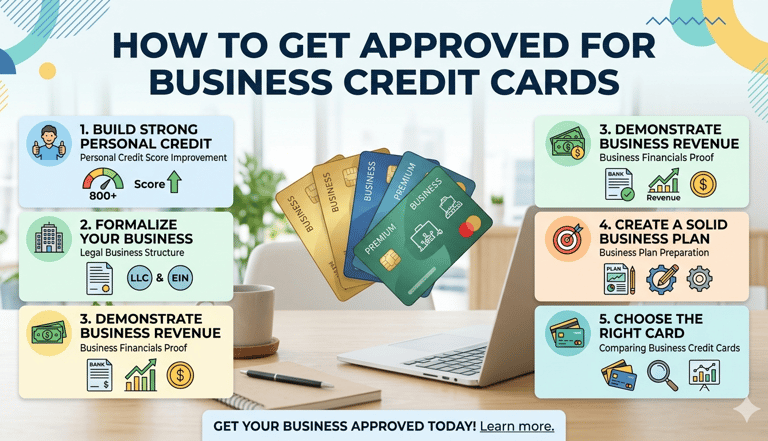
You applied for a business credit card. Got denied. And nobody clearly explained why.
That happens more than people talk about. Thousands of small business owners in the US apply for business credit cards every month and get rejected — not because their business is failing, but because they skipped some important steps before applying.
Understanding how to get approved for business credit cards is not just about having good personal credit. It is about building your business the right way, in the right order, so lenders see you as a low-risk borrower worth backing.
This guide walks you through exactly that. Step by step.
Why Business Credit Card Approval Is Harder Than You Think
Most business owners assume a business credit card works the same as a personal one. Just apply and get approved. But lenders see things differently.
When you apply for a business credit card, lenders want to know:
Does this business actually exist on paper?
Does it have its own credit history?
Is it set up like a real, operating business?
If you haven't built your business foundation first, the answer to most of those questions is no. And that leads to denial.
Here is something many people don't know: some business credit cards do not even pull your personal credit if your business profile is strong enough. That means the stronger your business looks on paper, the better your approval chances become — and the less it depends on your personal credit score.
Step 1: Set Up Your Business the Right Way
Before you apply for anything, your business needs to be structured properly. Lenders want to see a real, legitimate business — not just a name on a piece of paper.
Here is what that looks like:
Register Your Business as an LLC or Corporation
A sole proprietorship is tied directly to you as a person. An LLC (Limited Liability Company) separates your business from your personal finances. This matters a lot when it comes to building business credit independently.
If you haven't formed an LLC yet, that is the first step. It's one of the most important easy business credit approval steps that most beginners skip.
Get an EIN (Employer Identification Number)
An EIN is like a Social Security Number — but for your business. It's free, it takes minutes to apply through the IRS website, and it is required to open a business bank account, apply for business credit, and file business taxes.
Without an EIN, your business credit activity stays invisible to business credit bureaus. With one, you can start building a credit profile that belongs to your business, not just you personally.
Open a Business Bank Account
This is non-negotiable. Lenders look at your banking history. A business bank account shows that your business is active and handling real transactions.
Keep the account in good standing. Avoid overdrafts. Show regular deposits and activity. This alone can improve your chances of approval significantly.
Get a Business Phone Number and Address
Sounds small, but it matters. Many lenders verify your business on directories like Dun & Bradstreet or through 411 listings. If your business isn't listed, it looks like it doesn't exist. Use a dedicated business phone number and a real business address — not your personal home address if possible.
Step 2: Build Your Business Credit Profile Before You Apply
This is where most beginners go wrong. They try to apply for business credit cards with zero business credit history. That is like applying for a home loan on your first day of work.
You need to build a foundation first.
Start With Vendor Trade Lines
Trade lines are accounts with vendors or suppliers that report your payment history to business credit bureaus. When you pay on time, your business credit score goes up. Simple as that.
Some beginner-friendly vendors that report to business credit bureaus include companies like Uline, Grainger, and Quill. You don't always need good credit to open these accounts. You just need to pay on time.
Even two or three of these vendor accounts — paid consistently — can start building your business credit profile within 30 to 90 days.
Check Your Business Credit Reports
The three main business credit bureaus are Dun & Bradstreet, Experian Business, and Equifax Business. Each one tracks your business credit differently.
Pull your business credit reports and check:
Is your business listed correctly?
Are your payment histories showing up?
Are there any errors that need to be corrected?
Errors on your business credit file can hurt your approval chances. Review them early.
Get a DUNS Number
Dun & Bradstreet uses a DUNS Number to identify your business. It's free to register. And many lenders, especially larger ones, will check your D&B profile when reviewing your application.
Without a DUNS Number, you might not even exist in their system. Register it as early as possible.
Step 3: Know the Business Credit Requirements for Loan and Card Approval
Different lenders have different requirements. But most business credit card issuers look at a combination of the following:
Time in Business
Most lenders prefer businesses that have been operating for at least 6 months to 1 year. Some require 2 years. If your business is brand new, some issuers will still consider your personal credit as a backup — which is why your personal score still matters early on.
Revenue and Business Activity
Higher revenue means lower risk for the lender. Some credit cards require you to report your annual business revenue during the application. Be honest. Inflating numbers can lead to bigger problems later.
Personal Credit Score (For New Businesses)
For startups and newer LLCs, many issuers will use your personal credit as a secondary factor. A score above 680 is generally seen as acceptable. Above 700 gives you better approval odds and lower interest rates.
This is why business credit requirements for loan approval often include both business and personal factors — especially in the early stages.
Business Credit Score
As your business credit profile grows, this becomes more important than your personal score. Business credit scores work differently than personal ones. Dun & Bradstreet uses the PAYDEX score (0–100), while Experian and Equifax have their own scoring models.
A strong PAYDEX score of 80 or above — which means you pay on time or early — signals low risk to lenders.
Step 4: Choose the Right Business Credit Card for Your Stage
Not all business credit cards are the same. Some are designed for established businesses with years of revenue. Others are designed specifically for startups and newer LLCs.
Here are some categories to consider:
Secured Business Credit Cards
These require a cash deposit as collateral. Your credit limit is usually equal to what you deposit. They are easier to get approved for and are a smart starting point if your credit history is thin.
The deposit is returned when you close the account or upgrade. In the meantime, responsible use builds your credit profile.
Starter Business Credit Cards
Some issuers offer entry-level cards with lower approval thresholds. They may come with lower limits, but they get you started. The goal is not a huge limit right away — the goal is to start reporting positive payment history to the bureaus.
Store or Vendor Cards
Retail business cards — like those from Amazon Business, Office Depot, or specific fuel companies — are often easier to get approved for than major Visa or Mastercard business cards. Many report to business credit bureaus. These are great for building your credit starter profile as an LLC owner.
Step 5: Apply the Right Way
Now that your business is set up, your profile is building, and you know what card fits your stage — here is how to apply smartly.
Apply for one card at a time. Multiple applications in a short period create multiple hard inquiries, which can hurt both personal and business credit scores.
Match your business profile to the card requirements. Don't apply for a premium card that requires $500K in annual revenue if your business is three months old.
Use your EIN when possible. Some cards allow EIN-only applications without requiring your SSN. This keeps the credit activity on your business file instead of your personal one.
Prepare your documents. Some issuers ask for business registration documents, bank statements, or tax returns. Having these ready speeds up the process.
Keep your personal credit clean too. Even if your business credit is strong, lenders may cross-check your personal history. Avoid late payments and high personal credit utilization (the percentage of your total available credit that you're using) during the application period.
Common Mistakes That Lead to Rejection
Even when people follow most of the steps, small mistakes can still cause denials. Watch out for these:
Applying too early before any business credit history exists
Using a personal address instead of a registered business address
Not having a business bank account open and active
Inconsistent business information across applications, bank records, and credit bureaus
High personal credit utilization hurting your personal score
No DUNS Number or business bureau listing
Fixing these before you apply can make a big difference in your outcome.
Real Example: How One LLC Owner Got Approved in 90 Days
A small cleaning business in Texas registered as an LLC, got an EIN, opened a business bank account, and applied for three vendor trade line accounts. Within 60 days, their business credit file was active on two major bureaus. At day 90, they applied for a starter business credit card using their EIN — and got approved with a $3,500 limit.
No personal guarantee was required. No SSN used on the application. Just a properly structured business with a small but growing credit profile.
That is what following the right steps looks like in practice.
Business Credit Starter Guide for LLC Owners: Quick Recap
If you are an LLC owner just getting started, here is a simple checklist:
Form your LLC and register it properly
Apply for an EIN from the IRS (free)
Open a dedicated business bank account
Register for a DUNS Number (free)
List your business on 411 directories
Open 2–3 vendor trade line accounts
Pay all accounts on time, every time
Monitor your business credit reports monthly
Apply for a starter business credit card after 60–90 days
This is your real business credit starter guide for LLC owners who want to get approved the right way.
FAQs: Business Credit Card Approval
Q: Can I get a business credit card with no business credit history? Yes, but your personal credit will likely be used as the primary factor. Starting with secured business cards or vendor accounts first is a smarter approach.
Q: How long does it take to build business credit? With the right steps — EIN, vendor accounts, on-time payments — you can have an active business credit file within 30 to 90 days.
Q: Can I get a business credit card using only my EIN? Some issuers do allow EIN-only applications, but typically only when your business has an established credit profile. New businesses will usually still need to provide a personal guarantee or SSN at first.
Q: What credit score do I need for business credit card approval? Most issuers look for a personal score of 680 or above for newer businesses. As your business credit profile builds, your personal score becomes less important.
Q: What is the difference between business credit and personal credit? Personal credit is tied to your Social Security Number and reflects your individual financial behavior. Business credit is tied to your EIN and reflects how your business manages payments and debt. They are tracked separately.
Q: Do vendor trade lines really help build business credit? Yes. Vendor trade lines — accounts with suppliers who report to business credit bureaus — are one of the most effective ways to build a business credit profile quickly without taking on significant debt.
Final Thoughts: Build It Right, Get Approved Faster
Getting approved for business credit cards is not complicated. But it does require doing things in the right order.
Most denials happen because business owners skip the setup steps and go straight to applying. The lender sees no history, no foundation, no trust signal — and says no.
When you build your business properly, establish your credit profile through trade lines, and apply for cards that match your current stage, your approval chances go up significantly.
This is not about tricks or workarounds. It is about showing lenders that your business is real, active, and responsible.
If you want help putting together a business credit building plan — or figuring out which cards and accounts make sense for your specific situation — Altopex.com can guide you step by step. We work with small business owners across the US to help them build fundable businesses and access the credit and funding they deserve.