
Easy Ways to Build Business Credit Score Fast
Learn easy ways to build business credit score and get funding faster. Practical tips for US small business owners to improve business credit quickly.
BUSINESS CREDIT
Russel
6/2/20267 min read
Most small business owners apply for funding and get denied. Not because the business is failing. But because the business credit score is too low — or doesn't exist at all.
This happens more than you think. A lot of business owners run their companies for years and never build a separate business credit profile. They rely on personal credit. And when it's time to get a business loan, a line of credit, or vendor accounts — the doors stay closed.
The good news? Building business credit is not complicated. It just takes the right steps in the right order.
This guide covers the easiest and most effective ways to build your business credit score — even if you're starting from zero.
What Is a Business Credit Score and Why Does It Matter?
Your business credit score is a number that shows lenders and vendors how reliable your business is with money. It works like your personal credit score — but it's tied to your business, not you personally.
In the US, the main business credit bureaus are Dun & Bradstreet, Experian Business, and Equifax Business. Each has its own scoring model. Dun & Bradstreet uses a PAYDEX score (0–100). Experian Business uses a score from 1–100. Both matter when lenders and suppliers check your business credit.
Why does this matter for your business?
Lenders use it to decide if you qualify for loans or credit lines
Vendors use it to set payment terms and credit limits
Business credit cards with higher limits become accessible
You protect your personal credit from business debt
When your business credit score is strong, more funding options open up. And many of those options don't require a personal guarantee or SSN check.
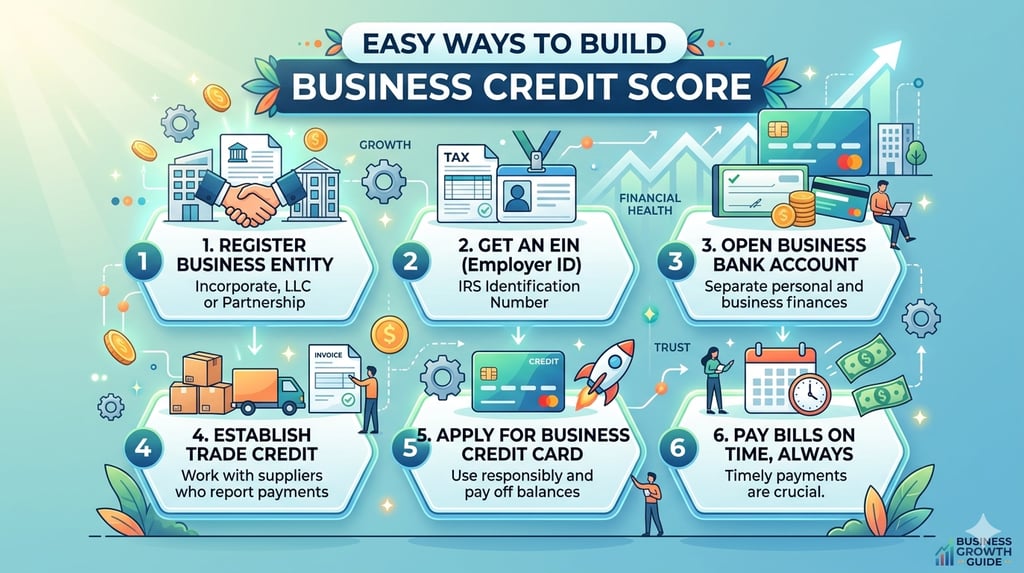
Step 1: Set Up Your Business the Right Way
This is where most business owners miss the first step. Before you can build business credit, your business needs to look legitimate in the eyes of lenders and credit bureaus.
Here's what you need in place:
LLC or Corporation — Register your business as a legal entity. A sole proprietorship doesn't separate your business and personal finances.
EIN (Employer Identification Number) — This is your business's tax ID, like a Social Security Number but for your business. Apply free through the IRS website.
Business bank account — Open a dedicated business checking account. Mixing personal and business money is a red flag for lenders.
Business phone number — Use a business landline or VoIP number listed in your business name.
Business address — A physical address or professional virtual office address. PO boxes alone don't build credibility.
Business website and email — Basic, but it matters. Lenders verify this.
These steps establish your business as a fundable entity. Without this foundation, your credit-building efforts won't stick.
Step 2: Get a D-U-N-S Number (Free)
If you want to build credit with Dun & Bradstreet — and you should — you need a D-U-N-S number. It's a unique 9-digit identifier for your business.
Getting one is free. Go to Dun & Bradstreet's website and request it. It can take a few weeks unless you pay for expedited processing.
Once you have a D-U-N-S number, lenders and vendors can find your business in the D&B database. This is important because your payment history with vendors gets reported there, and it directly affects your PAYDEX score.
Think of the D-U-N-S number as your business's credit identity card.
Step 3: Open Vendor Accounts That Report to Credit Bureaus
This is one of the fastest and easiest ways to build business credit — and most business owners don't know about it.
Vendor accounts (also called trade lines or net-30 accounts) are accounts where a supplier gives you products or services now, and you pay within 30, 60, or 90 days. When you pay on time, the vendor reports that positive payment history to the credit bureaus.
This builds your business credit score without needing a personal credit check in most cases.
Some well-known starter vendors that report to business credit bureaus include:
Uline (shipping and packaging supplies)
Quill (office supplies)
Grainger (industrial supplies)
Crown Office Supplies
Strategic Network Solutions (SNS)
Start with 3–5 vendor accounts. Buy small amounts. Pay early or on time. Let the positive payment history build your score over the first 3–6 months.
This is the core of quick business credit improvement — consistent, reported payment history.
Step 4: Open a Business Credit Card
Once you have a few vendor accounts reporting, you can apply for a business credit card. A business credit card is a revolving credit account — meaning you can use it, pay it off, and use it again.
Revolving credit is important for your score because it shows lenders you can manage an ongoing credit line responsibly.
Choose a business credit card that reports to business credit bureaus, not just personal. Some popular starter options include secured business credit cards from major banks, or cards specifically designed for businesses with limited credit history.
Tips for using your business credit card the right way:
Keep your credit utilization low — meaning don't use more than 30% of your limit at a time. Credit utilization is the percentage of your credit limit you're using. High utilization hurts your score.
Pay on time, every time.
Pay in full when possible to avoid interest charges.
Over time, your credit limit increases and your score improves. This is one of the most effective business credit score improvement methods for long-term growth.
Step 5: Pay Early, Not Just On Time
Most business owners focus on paying "on time." That's good. But paying early is better.
For Dun & Bradstreet's PAYDEX score, paying before the due date can push your score higher than simply paying on time. A PAYDEX of 80 means you pay on time. A PAYDEX above 80 means you pay early.
Lenders and vendors see that higher number and trust you more.
This one habit alone can separate your business from others competing for the same funding.
Step 6: Monitor Your Business Credit Reports
You can't improve what you don't track. Check your business credit reports regularly across all three bureaus — Dun & Bradstreet, Experian Business, and Equifax Business.
Look for:
Errors in your business name, address, or EIN
Accounts that aren't reporting correctly
Negative items that can be disputed
Errors on business credit reports are more common than people realize. A wrong address or a misreported late payment can pull your score down unfairly.
Monitoring also shows you where you stand, so you can make smarter decisions about when to apply for funding.
Step 7: Increase Your Credit Limits Over Time
As your business credit grows, request credit limit increases. More available credit with low utilization improves your score.
Call your vendors and card issuers after 6–12 months of good payment history. Ask for a limit increase. Most will say yes if your history is strong.
Higher limits also help when you need working capital for your business. A $5,000 credit line and a $25,000 credit line are very different when your business hits a slow month or needs to buy inventory fast.
Common Mistakes That Slow Down Your Business Credit Building
Even with the right strategy, some mistakes can hold you back. Avoid these:
1. Mixing personal and business finances This is the biggest mistake. Always keep your business accounts separate.
2. Using vendors that don't report to credit bureaus If a vendor doesn't report your payments, it doesn't help your score. Always confirm before opening an account.
3. Applying for too much credit at once Multiple hard inquiries in a short time can signal financial desperation. Space out your applications.
4. Neglecting business registration details Your business name, address, and EIN must be consistent everywhere — with lenders, vendors, and your bank. Inconsistencies cause problems.
5. Ignoring the credit bureaus Many business owners don't even know they have a business credit profile. By the time they check, the information is wrong or outdated.
How Long Does It Take to Build Business Credit?
This is the question every business owner asks. The honest answer: it depends on how consistent you are.
With the right steps:
3–6 months — You can have a basic business credit profile and a starting score
6–12 months — A solid score with vendor trade lines reporting
12–24 months — Strong enough credit to qualify for larger loans, lines of credit, and business credit cards with higher limits
There's no shortcut to skipping time. But there are shortcuts to doing it right from the start — which is what most business owners miss.
What Happens When Your Business Credit Is Strong?
When you have a solid business credit score, things change fast.
You can qualify for:
Business lines of credit (revolving access to cash when you need it)
Working capital loans without a personal guarantee
Net-30 and Net-60 vendor terms for purchasing
Business credit cards with limits of $10,000, $25,000, or more
SBA loans and bank financing at better rates
More importantly, you protect your personal finances. Business debt stays on the business. Your personal score isn't at risk every time you need capital.
That's the real power of building business credit — financial freedom and separation.
FAQs: Easy Ways to Build Business Credit Score
Q: Can I build business credit without a personal credit check? Yes. Many vendor accounts and trade lines don't require a personal credit check. Once your business credit is established, you can access funding using your EIN, not your SSN.
Q: How do I increase my business credit score fast? The fastest method is opening 3–5 vendor accounts that report to business credit bureaus, paying early, and keeping your business information consistent across all platforms. Results typically show within 60–90 days.
Q: What is the minimum credit score to get a business loan? It depends on the lender. Traditional banks often look for personal scores above 680 and a solid business credit history. Alternative lenders may work with lower scores if revenue and time in business are strong.
Q: Does opening a business bank account help build credit? Not directly. But having a business bank account is required to establish your business as fundable. It's a foundational step that supports your credit-building process.
Q: What's the difference between personal credit and business credit? Personal credit is tied to your SSN and reflects your personal financial behavior. Business credit is tied to your EIN and reflects how your business manages money. They are tracked separately and scored differently.
Q: Can a new LLC build business credit? Yes. Even a brand new LLC can start building business credit immediately by getting a D-U-N-S number, opening vendor accounts, and following the steps in this guide.
Q: How many trade lines do I need to get a business credit score? Most business credit bureaus need at least 3 active trade lines reporting to generate a score. More is better for depth and accuracy.
Conclusion: Start Building Your Business Credit Now
Building business credit is one of the most important things you can do for your business long term. It opens doors to funding, protects your personal finances, and gives you options when your business needs capital fast.
The process isn't complicated. But it does require the right steps, done in the right order, with consistency.
Most small business owners wait too long to start. Don't be one of them.
If you're ready to build your business credit the right way and want step-by-step guidance, Altopex.com can help. We work with US small business owners to set up their business credit profile, access vendor trade lines, and position their business for real funding. Reach out today — and let's get your business credit working for you.