
How to Get Your First Business Credit Account
Learn how to get your first business credit account as an LLC owner. Step-by-step guide for beginners to build business credit fast and get approved.
BUSINESS CREDIT
Russel
5/31/20267 min read
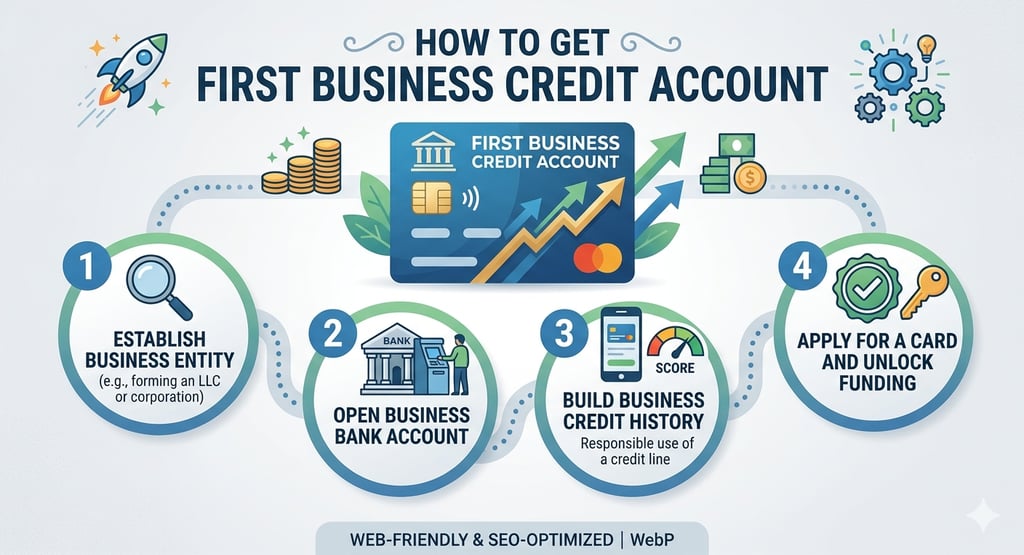
Most new business owners make the same mistake. They apply for business credit before their business is actually ready. Then they get denied. Then they get frustrated. And then they give up on building business credit altogether.
That's a costly mistake — because business credit, when built correctly, can give your company access to tens of thousands of dollars in funding without putting your personal finances on the line.
If you're starting from zero, this guide is for you. You'll learn exactly how to get your first business credit account, what lenders and vendors actually look for, and how to set yourself up so approvals become a normal part of your business growth.
Why Getting Your First Business Credit Account Is So Hard
When you're new, you have no credit history under your business name. No payment history. No credit score. Nothing on file.
Lenders and vendors want to see that your business is real, stable, and financially responsible. But to prove that, you need a credit history. And to get a credit history, you need accounts. It's a catch-22.
The good news? There's a way to break through it. It just takes the right steps — in the right order.
Step 1: Make Your Business Legally and Financially Separate
Before you apply for anything, your business needs to look like a real business on paper.
That means:
Form an LLC or corporation. A sole proprietorship doesn't separate your personal identity from your business. An LLC gives your business its own legal identity — which is the foundation of EIN-based business credit.
Get your EIN (Employer Identification Number). This is like a Social Security Number for your business. It's free to get from the IRS at irs.gov. Every business credit account you open will be tied to this number.
Open a dedicated business bank account. Use it only for business transactions. This shows financial discipline — something lenders and vendors pay close attention to.
Get a business phone number and address. These seem small, but they matter. Many vendors verify your business through 411 directory listings. If your business isn't listed or verifiable, some accounts won't be approved.
This is the business credit setup for beginners that most people skip — and it's exactly why many get denied at the first application.
Step 2: Register Your Business with the Right Credit Bureaus
Business credit bureaus are separate from personal credit bureaus. Equifax, Experian, and TransUnion track personal credit. Business credit is tracked by Dun & Bradstreet (D&B), Experian Business, and Equifax Business.
The most important one for beginners is Dun & Bradstreet. They issue a DUNS Number — a unique nine-digit identifier that tracks your business credit profile. Many vendors and lenders require this before they'll extend credit.
You can register for a DUNS Number for free at dnb.com. It can take a few weeks, so do this early.
Once you have your DUNS Number, your goal is to get accounts reporting to your D&B profile. That's what builds your Paydex Score — D&B's version of a business credit score. A Paydex of 80 or above shows you pay on time, and that's what opens more doors.
Step 3: Start with Business Credit Starter Accounts
You're not going for a $50,000 credit line on day one. You're starting with accounts that are designed for new businesses — sometimes called starter vendor accounts or net-30 accounts.
These are vendors that will extend you a small line of credit, let you buy products or services, and give you 30 days to pay. When you pay on time, they report it to business credit bureaus. That's how your business credit profile grows.
Some well-known vendor categories that work with new businesses include:
Office supply vendors — companies that sell office products and report to D&B
Business fuel cards — fleet cards for fuel purchases that report to business bureaus
Packaging and shipping supply vendors — useful for product-based businesses
Wholesale or trade suppliers — many report to Experian Business or D&B
The strategy here is simple. Open 3 to 5 starter accounts. Buy something small. Pay early or on time. Repeat for 60 to 90 days. By that point, your business credit profile starts to show real payment history — and that's what you need to move to the next level.
This is the core of any solid business credit starter guide for LLC owners.
Step 4: Don't Apply for Everything at Once
This is one of the most common business credit approval mistakes beginners make.
When you apply for multiple accounts in a short window, some bureaus and lenders flag it as risky behavior. It can hurt your approval chances and slow down your credit-building progress.
Instead, build in stages:
Stage 1 (Months 1–3): Focus on 3 to 5 starter vendor accounts. Pay on time. Let the payment history build.
Stage 2 (Months 3–6): Apply for a business credit card from a bank or credit union that offers cards to businesses with limited credit history. Some secured business credit cards are a good option here — they require a deposit but report to business credit bureaus and help establish your profile faster.
Stage 3 (Months 6–12+): With a growing credit profile, you can now qualify for better business credit cards, higher-limit accounts, and eventually, working capital loans or lines of credit.
Patience here pays off. A business that looks creditworthy after 12 months of consistent payment history is in a completely different position than one that rushed applications in month one.
Step 5: Keep Your Business Fundability Strong
Fundability is a term used to describe how "lendable" your business looks to lenders and credit issuers. It includes everything from your business age and legal structure to your credit profile and banking history.
Here's what most beginners overlook when learning how to establish business credit quickly:
Business age matters. The longer your business has been active, the more trustworthy it appears. This is another reason to register your LLC now, even if you're not fully operating yet. The clock starts when you form the entity.
Bank balance matters. Lenders often check your average daily bank balance. If your business bank account consistently shows low or negative balances, it signals financial instability. Try to maintain a stable balance — even if it's modest.
Business address matters. A home address can raise flags with some lenders. A registered business address or virtual office address can make your business look more established.
Industry matters. Some industries are considered higher risk by lenders (like cannabis, adult entertainment, gambling, etc.). If you're in a standard industry, this isn't a concern — but it's worth knowing.
These fundability factors work together. The stronger your overall profile, the easier credit approval becomes.
Step 6: Monitor Your Business Credit Reports Regularly
Once you have accounts open and reporting, you need to track what's being reported.
Check your D&B, Experian Business, and Equifax Business reports regularly. Look for:
Are your vendor accounts actually reporting?
Is your payment history showing as on-time?
Are there any errors or inaccurate information?
Errors on business credit reports do happen. And they can hurt your score or even block approvals. If you see something wrong, dispute it through the bureau's official process.
Monitoring also helps you know when you're ready to apply for the next level of credit. If your Paydex is climbing and your profile shows consistent payment history, that's your green light to move forward.
Practical Business Credit Approval Tips for Beginners
Here's a quick reference to keep in mind as you build:
Always pay early when possible. D&B's Paydex rewards early payments, not just on-time payments. Paying 10 to 15 days before the due date can push your score higher.
Don't close old accounts. Age of accounts matters. Keep older accounts open even if you use them rarely.
Keep credit utilization low. Credit utilization means the percentage of your available credit you're using. Staying under 30% is a good target.
Use your EIN, not your SSN, on business applications. Some applications give you the option. Using your EIN separates your personal and business credit profiles.
Stay consistent. Business credit is built over months, not days. Consistency in payments and account management is what moves the needle.
What Happens After You Build Your First Accounts
Once you have a real business credit profile, your options grow quickly.
You can qualify for business credit cards with higher limits. You can apply for vendor accounts with net-60 or net-90 terms. You can access working capital loans or business lines of credit from banks, credit unions, or alternative lenders.
More importantly, you can grow your business without relying on personal credit. No personal guarantee in many cases. No personal credit check. Your business becomes a financially independent entity — and that's one of the most powerful positions a small business owner can be in.
Frequently Asked Questions
How long does it take to get my first business credit account approved? It depends on how prepared your business is. If your LLC is set up, you have an EIN, and your business is listed and verifiable, many starter vendor accounts can be opened within a few days. The credit-building process typically takes 60 to 90 days before a solid profile starts to appear.
Can I build business credit without using my personal credit? Yes — and that's the goal. Many starter vendor accounts and some secured business credit cards do not require a personal credit check. As your business credit profile grows, more lenders will evaluate your business on its own merits.
What credit score do I need to get my first business credit account? For starter vendor accounts, you often don't need a credit score at all. These accounts are designed for businesses with no credit history. A business bank account, EIN, and verifiable business information are usually enough to get started.
Is an LLC required to build business credit? You can build business credit as a sole proprietor, but it's harder and less effective. An LLC gives your business a separate legal identity, which is the foundation for EIN-based credit building. Most credit experts recommend forming an LLC first.
What is a Paydex Score and why does it matter? A Paydex Score is Dun & Bradstreet's business credit score, ranging from 1 to 100. A score of 80 means you pay on time. A score above 80 means you pay early. Most lenders and vendors want to see a Paydex of 75 or higher before extending significant credit.
How many accounts do I need before applying for a business credit card? A good starting point is 3 to 5 trade accounts reporting on your D&B profile. After 60 to 90 days of positive payment history, you're in a much stronger position to apply for a business credit card.
Start Building Your Business Credit the Right Way
Getting your first business credit account isn't complicated — but it has to be done in the right order. Set up your business properly first. Get your EIN and DUNS Number. Open starter accounts. Pay on time. Monitor your profile. And then move forward systematically.
Skipping steps is what slows most business owners down. Following the process is what separates businesses that get funded from those that keep getting denied.
If you want hands-on help building your business credit from scratch — or if you're not sure where to start — Altopex.com can guide you through every step. From LLC setup to your first credit account to accessing real business funding, we help US small business owners build credit the right way.
Reach out to Altopex.com and let's get your business credit journey started.
Published by Altopex.com — Helping US Small Business Owners Build Credit and Access Funding