
Business Credit Setup for Beginners
Learn business credit basics for small business, how to establish business credit quickly, and get funding without risking your personal credit. Step-by-step guide.
BUSINESS CREDIT
Russel
6/5/20267 min read
Most small business owners don't think about business credit until they need funding. Then they apply — and get denied.
That's the trap. And it's avoidable.
Business credit setup for beginners isn't complicated, but it does take the right steps in the right order. Skip one step and lenders won't take you seriously. Follow the process and you can build a strong credit profile in months — not years.
This guide breaks it all down. Simple. Clear. Actionable.
What Is Business Credit and Why Does It Matter?
Business credit is your company's financial reputation. Lenders, vendors, and suppliers use it to decide if they'll extend credit to your business — and how much.
Here's what most beginners don't understand: business credit is completely separate from your personal credit.
That matters for two reasons.
First, it protects you personally. When your business has its own credit profile, you don't have to use your Social Security Number or personal credit score to get business funding. Your personal assets stay separate.
Second, it gives your business access to more money. Business credit lines and loans typically come with much higher limits than personal credit cards. Some established businesses get $50,000 to $250,000 in credit — through their business alone.
That kind of access changes what's possible for your company.
Business Credit Basics for Small Business Owners
Before you start building credit, you need to understand how the system works.
Business credit scores are tracked by three main agencies:
Dun & Bradstreet — uses a PAYDEX score (0–100)
Experian Business — tracks your business payment history
Equifax Business — monitors your business financial data
Lenders pull these reports when you apply for business funding. The stronger your profile, the better your approval odds and interest rates.
Unlike personal credit, your business credit profile is public. Anyone can look it up. That means vendors, partners, and lenders can check your business standing before doing business with you.
The good news? You don't need years of history to get started. With the right approach, you can establish business credit quickly — even in the first 30 to 90 days.
Step-by-Step: Business Credit Setup for Beginners
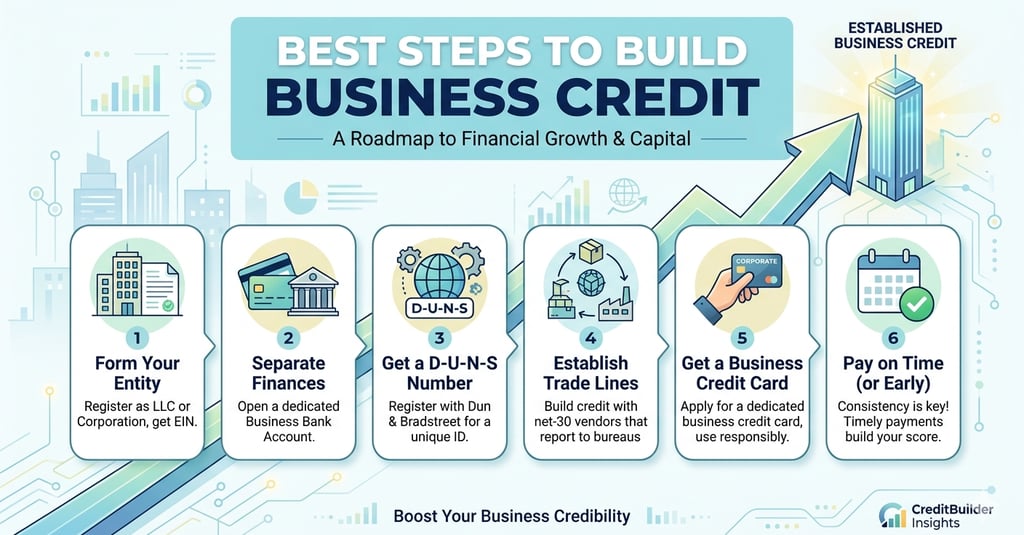
Step 1: Form a Proper Business Entity
Before anything else, your business needs a legal structure.
A sole proprietorship doesn't separate you from your business legally. That's a problem. You need a Limited Liability Company (LLC) or a corporation.
Forming an LLC gives you:
Legal separation between you and your business
A foundation lenders and vendors recognize
Protection for your personal assets if the business faces debt
Register your LLC in your state. This is usually done through your Secretary of State's office online. Cost ranges from $50 to $500 depending on your state.
Once formed, keep your business and personal finances completely separate.
Step 2: Get an EIN (Employer Identification Number)
Your EIN is your business's tax identification number. Think of it as a Social Security Number for your company.
You'll use your EIN to:
Open a business bank account
Apply for business credit
File business taxes
Register with vendors and suppliers
Getting an EIN is free. Apply directly on the IRS website at IRS.gov. You can get it instantly online.
This is a non-negotiable step. Without an EIN, you cannot build true EIN credit — and you'll always be relying on your personal credit instead.
Step 3: Open a Dedicated Business Bank Account
Your business needs its own checking account. Not a personal account you also use for business.
A dedicated business bank account does several things:
It shows lenders you're operating as a real business. It helps you track income and expenses cleanly. And it's often required before banks or lenders will consider you for a business credit card or loan.
Choose a bank that reports to business credit bureaus when possible. Ask them directly before opening the account.
Keep the account active. Run your business transactions through it. This history matters when lenders evaluate your fundability.
Step 4: Register With Dun & Bradstreet
Dun & Bradstreet is the most widely used business credit bureau. You need to exist in their system.
Get your D-U-N-S Number — it's Dun & Bradstreet's unique identifier for your business. It's free.
Go to DNB.com and register your business. This creates your business credit file. Once your file is active, lenders and vendors can look you up.
Without this, you're invisible to a major part of the business credit world.
Step 5: Get a Business Phone Number and Address Listed
This sounds minor. It isn't.
Lenders verify your business is real before extending credit. One of the first things they check: can they find your business in public directories?
Make sure your business has:
A dedicated phone number (not your personal cell)
A physical or registered business address
A listing on Google Business Profile
Presence on 411 directories
These things build credibility fast. They signal that your business is legitimate and established — even if you're just getting started.
Step 6: Open Vendor Accounts (Net-30 Accounts)
This is where the actual credit building begins.
Vendor accounts — sometimes called trade lines or net-30 accounts — let you buy products or services on credit. You receive the goods and pay the invoice within 30 days.
The vendors report your payments to business credit bureaus. When you pay on time, your business credit score grows.
Some beginner-friendly vendors that report to business bureaus include:
Uline — shipping and office supplies
Quill — office products
Grainger — industrial supplies
Crown Office Supplies — known for reporting to D&B
Start with two or three accounts. Buy small amounts. Pay early. Build a track record.
Even a few months of on-time payments can move your business credit score significantly.
Step 7: Apply for a Business Credit Card
Once you have a few vendor accounts and some payment history, it's time to get a business credit card.
A business credit card gives you:
A revolving credit line your business can use and reuse
Higher limits than personal cards in many cases
Rewards tailored to business spending (travel, office supplies, advertising)
Start with cards designed for newer businesses — many don't require a strong personal credit check if your business profile is building.
Keep your credit utilization low. Credit utilization means how much of your available credit you're using. Stay below 30%. Lower is better. High utilization hurts your score, even if you pay on time.
Step 8: Pay Everything on Time — Or Early
This rule is non-negotiable.
Business credit scoring rewards businesses that pay before the due date. A PAYDEX score of 80 (the standard "good" score at D&B) requires you to pay on time. To reach 90 or above, you need to pay early.
Set up reminders or auto-pay. Late payments can drop your score fast and make future funding much harder to get.
How to Establish Business Credit Quickly
You want to fast track business credit building? Here's how to compress the timeline.
Do everything at once. Don't wait to finish one step before starting the next. Form your LLC, get your EIN, open your bank account, and register with D&B all in the same week.
Start with easy approvals. Go for vendors and credit products designed for newer businesses. Getting denied on multiple applications early on can slow you down. Build a base first.
Use your accounts regularly. A dormant trade line doesn't build credit. Buy small items. Pay them. Repeat.
Check your business credit reports. Watch your reports on D&B, Experian, and Equifax Business. Errors happen. Dispute anything inaccurate right away.
Add more trade lines over time. Each account that reports positive payment history strengthens your profile. Aim for 5 or more active trade lines within your first year.
Follow these steps and many business owners go from zero credit history to a solid business credit profile in 3 to 6 months.
Common Mistakes That Slow Down Business Credit Building
A lot of beginners make the same errors. Avoid these:
Mixing personal and business finances. This is the fastest way to undermine your business credit. Keep everything separate — accounts, cards, and expenses.
Not registering with credit bureaus. If the bureaus don't know your business exists, your payment history won't be recorded. Register proactively.
Applying for too much credit too fast. Multiple hard inquiries in a short period can lower your score. Space out your applications.
Only paying minimums. Paying off balances in full — or at least staying well below your credit limit — shows financial discipline.
Ignoring your reports. You can't manage what you don't monitor. Check your business credit reports regularly.
What Lenders Actually Look For
When you apply for a business loan, line of credit, or working capital financing, lenders look at a specific set of factors:
Time in business — Many lenders want at least 6 months, some require a year or more
Business credit score — Higher scores mean better approval odds and lower rates
Business bank account activity — Steady cash flow through a business account matters
Annual revenue — Most lenders set minimum revenue requirements
Industry type — Some industries are considered higher risk
Building business credit doesn't guarantee approval. But it dramatically improves your chances. Many lenders won't even look at your application without a business credit profile — especially for larger amounts.
Fast Track Business Credit Building: Timeline Overview
Here's what a realistic credit-building timeline looks like:
Month 1: Form LLC, get EIN, open business bank account, get D-U-N-S number, set up business phone and address
Month 2–3: Open 3–5 vendor (net-30) accounts, make small purchases, pay invoices early
Month 3–4: Apply for a starter business credit card, keep utilization low, continue paying vendor accounts on time
Month 4–6: Add more vendor accounts and a second business credit card, monitor all three business credit reports
Month 6–12: Apply for a business line of credit or working capital loan, leverage growing credit profile for better terms
This isn't overnight. But it's fast if you stay consistent.
FAQ: Business Credit Setup for Beginners
Q: Can I build business credit with no personal credit history?
Yes. Business credit is built through your business's payment history — not yours personally. However, some lenders still review personal credit as part of the application, especially for newer businesses.
Q: How long does it take to establish business credit?
You can begin building your credit profile in 30 days by setting up your LLC, EIN, and registering with D&B. A meaningful credit profile with multiple trade lines typically takes 3 to 6 months of active building.
Q: Do I need an LLC to build business credit?
You don't legally need an LLC — an S-Corp or C-Corp also works. But a sole proprietorship ties everything to your SSN and personal credit. An LLC or corporation is strongly recommended.
Q: What is a good business credit score?
On the D&B PAYDEX scale, 80 is considered good (on-time payments). A score of 90 or above indicates early payment and is where most premium lenders want to see you.
Q: Can I build business credit if my personal credit is bad?
Yes. Business credit is separate. You can build a strong business credit profile regardless of your personal credit history. Some funding options specifically avoid personal credit checks entirely.
Q: How many vendor accounts do I need?
Start with at least 3 to 5 active vendor accounts reporting to business credit bureaus. The more accounts with positive payment history, the stronger your profile becomes.
Final Thoughts
Business credit setup for beginners doesn't have to be overwhelming.
Take it one step at a time. Form your entity. Get your EIN. Open a business bank account. Start with vendor accounts. Pay early. Build from there.
Small, consistent steps lead to a strong credit profile. And a strong credit profile leads to better funding — with better terms, higher limits, and more options for your business.
The businesses that grow fastest aren't always the most profitable. They're the ones that know how to access capital when they need it.
That starts with business credit. And it starts today.