
Fast Track Business Credit Building Guide (2026)
Learn how to fast track business credit building with proven steps. Build EIN credit, open vendor accounts, and get funding faster — without using your SSN.
Russel
6/8/20268 min read
Most small business owners wait too long to start building business credit. Then when they need funding — a loan, a credit card, a line of credit — they find out their business has no credit history at all.
That's a painful position to be in.
The good news? You don't need years to build solid business credit. If you know the right steps, you can fast track business credit building and start seeing real results within a few months.
This guide breaks it all down — clearly, simply, and in the right order.
What Is Business Credit and Why Does It Matter?
Business credit is your company's financial reputation. It's separate from your personal credit score.
Lenders, suppliers, and vendors use it to decide if they should extend credit to your business. Think of it like a report card — but for your company.
When your business has strong credit, you can:
Get approved for business credit cards with higher limits
Access working capital loans and lines of credit
Open vendor accounts with better payment terms
Qualify for funding without putting your personal credit at risk
When your business has no credit — or bad credit — most lenders say no. Or they ask for personal guarantees, which ties your personal finances to your business debt. That's a risk you don't want.
Building business credit the right way removes that risk. It gives your business its own financial identity.
Why Most Business Owners Are Building Credit Too Slowly
The biggest mistake? Waiting for credit to "happen."
Some business owners assume that just running a business for a few years automatically builds credit. It doesn't. Not unless you take specific steps to establish and grow it.
Others try random things — applying for a business credit card here, signing up with a vendor there — without a clear strategy. That approach wastes time and can actually slow you down.
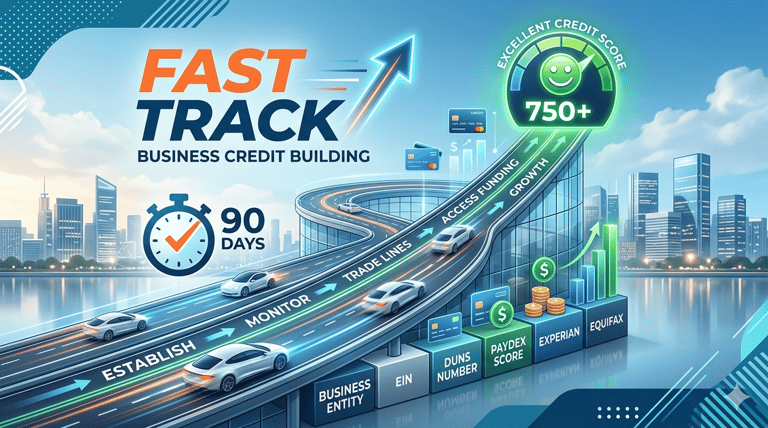
To fast track business credit building, you need a structured path. Step one leads to step two. Step two opens the door for step three. Skip steps and the whole process stalls.
Here's what that path looks like.
Step 1: Make Your Business Legible to Lenders
Before any credit can be built, your business has to look real and credible on paper. This is called fundability — basically, how ready your business looks to receive funding.
To build fundability, make sure you have:
An LLC or Corporation Sole proprietorships don't separate your personal and business finances. Register your business as an LLC or corporation. This is the foundation of EIN credit — credit built under your business's tax ID number, not your Social Security number.
An EIN (Employer Identification Number) This is your business's version of a Social Security number. Apply for it free at IRS.gov. You'll use your EIN to open business bank accounts, apply for credit, and file taxes.
A Business Bank Account Lenders want to see a real business bank account. Open one in your business's legal name. Keep it active. This alone builds trust with many lenders and credit bureaus.
A Business Address and Phone Number Use a real business address — not a PO Box. Have a dedicated business phone number listed on Google and your website. These small things affect your business's credibility score.
A DUNS Number Dun & Bradstreet (D&B) is one of the major business credit bureaus. Get a free DUNS number at dnb.com. This registers your business in their system and makes you visible to trade creditors.
Getting all of this in place isn't exciting work. But it's essential. Without it, you can't move forward.
Step 2: Open Starter Vendor Accounts (Trade Lines)
This is where most people get stuck — or skip entirely. And it's actually the fastest way to start building real credit.
Vendor accounts (also called trade lines) are accounts with suppliers who give you credit to buy goods or services and then pay later — usually net 30, 60, or 90 days. When you pay on time, they report your payments to the business credit bureaus.
That's how your business credit history gets built.
Some vendors don't require a personal credit check. They'll extend credit based on your EIN and business registration alone. These are called starter vendors or net-30 accounts.
Examples of categories where you can find starter vendors:
Office supply companies
Business printing and marketing suppliers
Shipping and packaging vendors
Business education or tools providers
Apply for 3–5 of these starter accounts. Use them. Pay on time or early. This builds your business credit profile at bureaus like Dun & Bradstreet, Experian Business, and Equifax Business.
Once you have 3–5 trade lines reporting, you have a credit history. That opens the next door.
Step 3: Monitor Your Business Credit Reports
You can't manage what you don't measure.
Once you start opening accounts and building activity, pull your business credit reports regularly. Watch for:
New accounts being reported
Payment history showing up
Any errors or wrong information
The three main business credit bureaus are:
Dun & Bradstreet — tracks your Paydex score (payment history score)
Experian Business — reports on credit usage and payment patterns
Equifax Business — tracks business credit activity and risk scores
Errors on your business credit report can hurt your score and your chances of getting approved for funding. Dispute anything that looks wrong immediately.
Staying on top of your reports is a quick business credit improvement method that many business owners overlook. Don't skip it.
Step 4: Apply for Business Credit Cards
Once you have some trade lines reporting, you're ready for the next level — business credit cards.
Business credit cards help in two ways. First, they add another line of credit to your business profile. Second, they give you working capital to run your operations.
When looking for a business credit card, focus on:
Cards that report to business bureaus — not all do. Some report only to personal bureaus, which doesn't help your business credit at all.
Cards that don't require a personal guarantee — once your business credit is established, some cards will approve based on business credit alone. This protects your personal finances.
Low credit utilization — this means keeping your balance well below your credit limit. For example, if your card limit is $5,000, try to keep your balance under $1,500. Credit utilization is the ratio of what you owe to your credit limit. Keeping it low improves your business credit score.
Start with 1–2 business credit cards. Use them for small recurring expenses. Pay them on time — every time.
Step 5: Keep Your Credit Utilization Low
This is one of the most important — and most overlooked — quick business credit improvement methods.
Credit utilization applies to both business credit cards and revolving credit lines. Revolving credit means a credit line you can borrow from, pay back, and borrow again — like a credit card or a business line of credit.
The lower your utilization, the better your score. Most business credit experts recommend staying below 30% utilization on any given account.
If you have a $10,000 credit line, try not to carry more than $3,000 in balance at any time.
High utilization tells lenders your business is financially stretched. Low utilization tells them your business is disciplined and financially healthy.
Step 6: Add More Credit Accounts Over Time
Business credit building is not a one-time task. It's a growing process.
As your profile matures, gradually add more accounts:
More vendor/trade lines in different categories
A business line of credit from a bank or credit union
Fleet cards or fuel cards (if relevant to your business)
Equipment financing (if you need equipment)
Each account adds depth to your business credit history. Lenders want to see that you can manage multiple types of credit responsibly.
This is part of your business credit building timeline guide — the idea that your profile grows in layers, month over month, quarter over quarter.
Business Credit Building Timeline: What to Expect
Here's a realistic view of your fast track business credit building timeline:
Month 1–2: Foundation Set up your LLC, EIN, business bank account, DUNS number, and business address. Get everything aligned and credible.
Month 2–4: Starter Accounts Open 3–5 net-30 vendor accounts. Use them for small purchases. Pay on time.
Month 4–6: Credit Reporting Begins Your trade lines start reporting. Your Paydex score and Experian Business score begin to develop. This is where your business credit profile becomes real.
Month 6–9: First Business Credit Card Apply for a business credit card. Keep utilization low. Pay on time.
Month 9–12: Stronger Profile Add more accounts. Monitor reports. Dispute errors. Your profile is growing.
Month 12–18: Funding Access With a solid business credit profile, you now qualify for better funding options — higher credit limits, working capital loans, and lines of credit — often without a personal guarantee.
This is a realistic timeline for most small business owners who follow the steps consistently.
Common Mistakes That Slow Down Business Credit Building
Avoid these pitfalls:
Applying for too many accounts at once. Every credit application can trigger an inquiry. Too many at once looks risky to lenders. Space out your applications.
Mixing personal and business finances. Keep them completely separate. Use your business account for business expenses only. Commingling finances hurts both your fundability and your taxes.
Ignoring your business credit reports. Errors happen. Catch them early and dispute them.
Paying late. One late payment can damage your Paydex score significantly. Set reminders. Pay early if you can.
Skipping the foundation steps. If your business isn't properly set up (LLC, EIN, address, DUNS), no vendor or lender will take you seriously. Foundation first. Everything else follows.
FAQ: Fast Track Business Credit Building
How long does it take to build business credit? Most business owners see their first real credit profile within 3–6 months of consistent steps. A strong, fundable profile typically takes 12–18 months. Rushing without structure usually backfires.
Can I build business credit without using my SSN? Yes. Once your LLC and EIN are established, many vendor accounts and some business credit cards can be opened using your EIN only — no SSN required. This is the foundation of EIN credit.
What is the fastest way to build business credit? Start with your business foundation (LLC, EIN, DUNS), then open 3–5 starter vendor accounts immediately and pay on time. This is the quickest legitimate path to getting your business credit profile started.
Does a business credit card help build business credit? Only if it reports to business credit bureaus. Always check before applying. Cards that report only to personal bureaus do not help your business credit score.
What credit score do I need for a business loan? It varies by lender. Some lenders look at your Paydex score (aim for 80+), while others look at your Experian Business or Equifax Business scores. Stronger credit across all bureaus improves your approval chances significantly.
How many trade lines do I need to start? Start with at least 3 reporting trade lines. This gives credit bureaus enough data to generate a business credit score. More is better over time.
Final Thoughts
Building business credit is not complicated. But it does require the right steps in the right order.
Most small business owners skip the foundation and wonder why they can't get approved for funding. The ones who follow the full process — LLC, EIN, vendor accounts, trade lines, business credit cards, low utilization — are the ones who end up with strong business credit profiles and real funding access.
You don't need to rush. You need to be consistent.
Start with your foundation today. Open your first vendor accounts this month. Pay on time. Monitor your reports. That's how you fast track business credit building the right way — without shortcuts that backfire.
Need help getting started?
If you want personalized guidance on building your business credit and accessing funding, Altopex.com can walk you through every step. From setting up your LLC and EIN to opening the right vendor accounts and qualifying for business credit cards and working capital — we help US small business owners build real, bankable credit.
Reach out to Altopex.com today and start your business credit journey with a clear plan.