
Easy Business Credit Approval Steps: The Complete Guide for Small Business Owners
Easy Business Credit Approval Steps (2026 Guide) Meta Description: Learn the easy business credit approval steps every small business owner needs. Build EIN credit, get approved for business cards, and access funding fast.
BUSINESS CREDIT
Douglas G. Marsh
5/21/202631 min read
Introduction: Most Small Business Owners Are Getting This Wrong
Getting approved for business credit is not as complicated as most people think. But most small business owners go about it the wrong way. They apply too soon. They use the wrong structure. They skip the foundational steps that lenders actually look at.
And then they wonder why they keep getting rejected.
Here is the truth. Business credit approval is not a mystery. It follows a clear process. If you set up your business the right way, build your credit profile step by step, and approach lenders at the right time, your chances of getting approved go up significantly.
This guide will walk you through the easy business credit approval steps that work in 2026. Whether you are just starting out or you have been in business for a few years but never built your credit profile, this guide is for you.
We will cover everything. How to set up your business foundation. How to build your EIN credit. How to choose the right vendor accounts and trade lines. How to get approved for business credit cards. And how to eventually qualify for working capital loans and larger funding.
Let us get into it.
What Is Business Credit and Why Does It Matter?
Before we talk about approval steps, let us make sure we are on the same page about what business credit actually is.
Business credit is a credit profile that belongs to your business. Not to you personally. It is tied to your EIN (Employer Identification Number), which is basically your business's version of a Social Security Number.
When your business has its own credit profile, lenders and vendors can evaluate your business separately from you as an individual. This means you can access funding, trade lines, and credit cards based on your business's financial history, not just your personal credit score.
This is powerful for a few reasons.
First, it protects your personal credit. If your business takes on debt or maxes out a credit card, it does not automatically hurt your personal score.
Second, it gives you access to higher limits. Business credit limits are typically much higher than personal credit limits because lenders are evaluating your business's revenue and potential, not just your personal income.
Third, it builds long-term fundability. The longer and stronger your business credit profile, the easier it becomes to get approved for bigger loans, better terms, and more flexible financing options over time.
Now let us talk about how to actually build it.
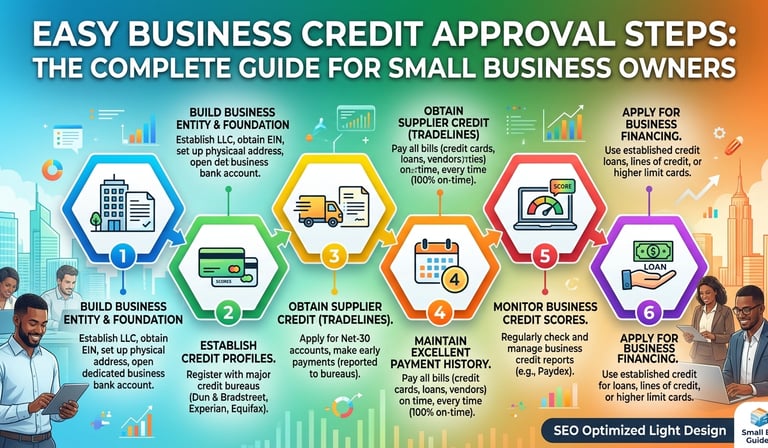
Step 1: Set Up Your Business the Right Way
This is where most small business owners either skip ahead or make mistakes. And it affects everything that comes after.
Before you can build business credit, your business needs to look legitimate to lenders. Not just operate legitimately, but look it. Lenders and credit bureaus check specific things before they approve your business for any form of credit.
Form an LLC or Corporation
If you are currently operating as a sole proprietor, you need to change that. A sole proprietorship is legally the same as you, the person. There is no separation between you and your business. That means there is no real "business" to build credit for.
Form an LLC (Limited Liability Company) or a corporation. An LLC is usually the simplest and most flexible structure for small business owners. It creates a legal separation between you and your business, which is the foundation of all business credit building.
The process is different in each state, but generally you file articles of organization with your state and pay a small fee. In most states, you can do this online in under an hour.
Once your LLC is formed, your business becomes a separate legal entity. Now it can have its own bank accounts, its own credit profile, and its own financial history.
Get Your EIN
An EIN is a nine-digit number issued by the IRS that identifies your business for tax purposes. Think of it as your business's Social Security Number.
You can get an EIN for free directly from the IRS website in minutes. There is no cost and no reason to use a third-party service for this.
Your EIN is what ties your business credit profile together. Every credit account, vendor account, and loan you open under your business name will reference this number. The business credit bureaus (Dun & Bradstreet, Experian Business, and Equifax Business) use it to identify and track your business.
Without an EIN, you cannot build business credit. Full stop.
Get a DUNS Number
Dun & Bradstreet is one of the three major business credit bureaus, and they use a DUNS number (Data Universal Numbering System) to identify businesses in their database.
You need to register for a free DUNS number at the D&B website. This creates your business profile in their system, which is where many lenders check business credit.
Getting your DUNS number is free. It can take a few days to process. Do this early in the process because some of the vendor accounts you will apply for later check D&B specifically.
Set Up a Business Address
Your business needs a real, verifiable address. Not a P.O. box. Not your personal home address (ideally).
If you work from home, using your home address is acceptable in many cases. But if you want to build the strongest possible business credit profile, consider getting a virtual office address from a provider like Regus or similar services. These give you a real street address that looks professional and consistent across all your applications.
Consistency matters here. The address on your EIN application, your business license, your bank account, and your credit applications should all match. Inconsistencies raise flags with lenders.
Get a Business Phone Number
Your business needs a dedicated phone number listed under your business name. Not your personal cell phone.
You can get a business VoIP number cheaply through services like Google Voice (free), Grasshopper, or RingCentral. The important thing is that the number is listed in the business name.
Why does this matter? Because lenders often verify your business through directory listings. If your business name, address, and phone number are not consistent and verifiable, some lenders will decline you even before they look at your credit.
Get a Business Bank Account
A dedicated business bank account is not optional. It is a requirement.
If you mix personal and business finances, lenders see this as a red flag. It signals that you are not running a real, organized business.
Open a business checking account under your LLC or corporation name using your EIN. Use it exclusively for business transactions. This builds a financial track record for your business and is often required when applying for business loans and credit cards.
Some banks also report your account activity to business credit bureaus, which can help your profile.
Step 2: Register Your Business Everywhere It Matters
Once your business structure is set up, you need to make it visible and verifiable in all the right places.
Get a Business License
Depending on your state and industry, you may need a general business license, a professional license, or a local operating permit. Check with your city and county to find out what is required.
Having a current, valid business license adds legitimacy to your profile. Some lenders specifically ask for proof of licensure.
Create a Business Website and Email
Your business needs a professional website and an email address that uses your business domain. Not a Gmail or Yahoo address.
A website does not need to be elaborate. Even a simple, clean, one-page site that explains what your business does is enough. The important thing is that it is live, uses your business name, and has contact information that matches your other registrations.
A domain-based email like info@yourbusiness.com signals professionalism and consistency to lenders. It costs very little and takes minutes to set up.
List Your Business in 411 and Online Directories
Go to 411.com and search for your business. If it is not listed, you can add it. This is where many lenders verify business contact information.
Also list your business on Google Business Profile, Yelp (even if you do not want reviews, it confirms your existence), and the Better Business Bureau if applicable.
The goal is that when a lender looks up your business name, phone number, and address, they find consistent information everywhere.
Step 3: Open Vendor Accounts (Trade Lines)
This is where business credit building actually begins. And this is one of the most important easy business credit approval steps many people overlook.
Trade lines are credit accounts you open with suppliers or vendors who offer net terms. Net terms mean they let you buy now and pay later. For example, net-30 terms mean you have 30 days to pay the invoice.
The key is to find vendors who report your payment history to business credit bureaus. Not all vendors do this. The ones that do are often called "starter vendors" or "net-30 vendors."
Why Trade Lines Matter
When you pay your vendor invoices on time, those payments get reported to D&B, Experian Business, or Equifax Business. This builds positive payment history on your business credit profile. Over time, this history becomes the foundation of a strong business credit score.
Think of it like building personal credit with a secured card. You start small, make on-time payments, and your score grows.
Starter Vendors to Consider
There are several vendors well-known for working with new businesses and reporting to business credit bureaus. Here are some categories to look into:
Office and Business Supplies: Some office supply companies offer net-30 accounts to businesses with basic requirements like a registered LLC, EIN, and business bank account.
Shipping and Logistics Vendors: Certain freight and shipping vendors offer net-30 accounts and report to business credit bureaus.
Wholesale and Distributor Accounts: Some wholesale product suppliers offer trade credit to new businesses and report account activity.
Business Service Providers: Some business service companies that offer subscriptions or ongoing services extend net terms and report payment activity.
Do your research on each vendor before applying. Look for three things: do they report to business credit bureaus, what are their minimum requirements, and are they legitimate businesses.
How Many Trade Lines Do You Need?
To establish a business credit score, you generally need at least three to five trade lines reporting positive payment history. The more accounts you have reporting on-time payments, the stronger your profile becomes.
Start with three to five accounts. Use them for actual business purchases, even small ones. Pay every invoice on time or early. Early payment can sometimes result in better terms or higher limits down the road.
Step 4: Build Your Business Credit Score
Now that you have trade lines in place and payments reporting, your business credit score will start to build. But let us understand what these scores mean and how they are calculated.
The Three Business Credit Bureaus
Dun & Bradstreet (D&B): D&B assigns a PAYDEX score from 0 to 100. A score of 80 or above means you are paying on time. A score of 100 means you always pay early. Lenders love seeing a PAYDEX score of 80 or higher.
Experian Business: Experian uses an Intelliscore Plus that ranges from 0 to 100. Higher is better. Factors include payment history, credit utilization (how much of your available credit you are using), and the age of your accounts.
Equifax Business: Equifax uses a Payment Index score and a Credit Risk score. These range from 0 to 100 and 101 to 992 respectively. Again, higher scores reflect lower risk and better payment history.
Different lenders check different bureaus. Some check all three. That is why it is important to build a profile on each one.
What Affects Your Business Credit Score
Payment history is the biggest factor. Paying on time or early consistently is the fastest way to build a strong score.
Credit utilization is how much of your available credit you are using. On revolving accounts like credit cards, try to keep your balance below 30% of your limit. Lower is even better. If your credit limit is $10,000, try not to carry a balance above $3,000.
Age of accounts matters. Older accounts with positive history improve your score over time. This is why starting early is always better.
Number of accounts reporting to the bureaus also matters. More accounts with positive history generally equals a stronger score.
Public records like liens, judgments, or bankruptcies will significantly hurt your score. Keep your business finances clean.
How Long Does It Take to Build Business Credit?
With consistent effort, you can establish a basic business credit profile in three to six months. Building a strong profile that qualifies for significant funding typically takes one to two years.
The good news is that business credit can build faster than personal credit when you do it strategically. With the right trade lines and consistent payments, you can reach a strong PAYDEX score in as few as six months.
Step 5: Monitor Your Business Credit Reports
Once you start building credit, you need to monitor it. Errors on business credit reports are more common than you think. And unlike personal credit, businesses do not always have automatic notification rights or dispute processes that are as straightforward.
Where to Monitor Your Reports
Dun & Bradstreet: D&B offers a free business credit report option, and you can pay for more detailed monitoring through their services. Check your PAYDEX score and the accounts being reported.
Experian Business: Experian offers business credit report products you can purchase to monitor your profile.
Equifax Business: Similarly, Equifax offers paid business credit monitoring services.
What to Look For
Review each report for accuracy. Check that your business name, address, and EIN are correct. Check that the accounts being reported are accounts you actually opened. Verify that the payment history shown matches your actual payments.
If you find errors, dispute them with the bureau directly. Provide documentation showing the correct information.
Monitoring also helps you track your progress and know when you are ready to apply for the next level of credit.
Step 6: Apply for Business Credit Cards
Once you have at least three to five vendor accounts reporting positive payment history for three to six months, you may be ready to apply for a business credit card.
Business credit cards are a major milestone. They often come with higher limits, business-specific rewards, and reporting to business credit bureaus. Some business credit cards do not report to personal credit bureaus at all, which keeps your business finances completely separate from your personal profile.
Business Credit Card Basics
A business credit card works similarly to a personal credit card. You have a credit limit, you make purchases, and you receive a statement each month. Pay the balance on time (ideally in full) to avoid interest charges and build positive credit history.
Many business credit cards offer rewards like cash back, travel points, or statement credits on common business expenses like office supplies, fuel, advertising, and utilities.
Types of Business Credit Cards
EIN-Only Business Credit Cards: Some business credit cards can be obtained using your EIN only, without a personal guarantee or personal credit check. These are harder to qualify for as a new business but become more accessible as your business credit profile grows. They protect your personal credit entirely.
Personal Guarantee Business Cards: Most business credit cards, especially for newer businesses, require a personal guarantee. This means the card issuer can come after you personally if the business defaults. These are easier to get but do connect to your personal credit in some ways.
Secured Business Credit Cards: If your business credit is new or your personal credit is not strong, a secured business credit card is a good starting point. You put down a deposit (usually equal to your credit limit), which reduces the lender's risk and makes approval more accessible.
Business Credit Card Approval Requirements
Here are the typical business credit requirements for credit card approval. Different issuers have different standards, but these are common factors:
Business structure: You need an LLC, corporation, or registered business. Sole proprietors can apply too, but registered businesses often get better terms.
EIN: Most issuers want your EIN on the application.
Time in business: Many credit card issuers want to see at least six months to one year in business. Some work with newer businesses.
Business revenue: Issuers may ask for annual or monthly revenue. Be honest here. Some will verify through bank statements.
Personal credit score: For cards requiring a personal guarantee, a personal score of 650 or higher is usually the baseline. Higher scores get better terms.
Existing business credit: Having established trade lines and a positive PAYDEX score can improve your chances significantly, even if your business is new.
How to Improve Your Chances of Approval
Apply for business credit cards that match where you are. Do not apply for premium cards with high requirements when you are just starting out. Start with cards designed for newer or smaller businesses and work your way up.
Keep your personal credit clean while building business credit. Most issuers check both.
Apply for one card at a time. Multiple hard inquiries in a short period can hurt your personal credit and raise flags.
Make sure your business information on the application matches everything else, your bank records, your registration documents, and your credit reports.
Step 7: Understanding Business Credit Requirements for Loan Approval
Once your business credit is established, you may want to access larger funding. Working capital loans, SBA loans, equipment financing, and business lines of credit are all possibilities. But each has different business credit requirements for loan approval.
What Lenders Look for in Business Loan Applications
Credit scores: Lenders check your business credit scores from D&B, Experian, and Equifax. A PAYDEX score of 75 or above is generally considered good. For larger loans, 80 or above is often preferred.
Personal credit score: Most lenders, especially traditional banks and SBA lenders, also check your personal credit score. A score of 680 or above is generally a baseline for most loan products. Some alternative lenders will work with scores in the 600s.
Time in business: Lenders want to see stability. Most traditional lenders want at least one to two years in business. Some alternative lenders work with businesses as young as six months.
Annual revenue: Lenders want to know you can repay the loan. They will ask for bank statements, tax returns, or profit and loss statements to verify your revenue. Many lenders want to see at least $100,000 in annual revenue for working capital loans, though some alternative lenders have lower thresholds.
Debt-to-income ratio: If your business already has significant debt, lenders may be hesitant to add more. Keeping your existing debt manageable improves your chances.
Business assets: Some loans, especially equipment or real estate financing, use assets as collateral. Having business assets can open up secured loan options.
Industry risk: Some industries are considered higher risk by lenders (restaurants, cannabis, construction). This does not mean you cannot get funded, but it may affect your options and rates.
Types of Business Loans and Their Requirements
SBA Loans (Small Business Administration): SBA loans are backed by the government, which reduces lender risk. They typically offer the best interest rates and longest repayment terms. But the requirements are also the strictest. Most SBA lenders want at least two years in business, strong personal and business credit, and solid financial documentation. The process is longer, sometimes several weeks to months.
Bank Business Loans: Traditional bank loans require strong business credit, good personal credit, time in business, and financial documentation. Banks are generally conservative lenders. If you have a strong profile and relationship with a bank, you can get excellent terms. But if you are early in your business journey, a bank may not be your first option.
Online Business Lenders: Alternative online lenders have expanded significantly in recent years. They often have faster approval times (sometimes same-day or next-day) and lower requirements than traditional banks. The tradeoff is typically higher interest rates. Online lenders are a good option for businesses that need funding quickly or do not yet qualify for traditional bank loans.
Business Lines of Credit: A business line of credit works like a credit card. You are approved for a maximum credit limit, and you can draw from it as needed, paying interest only on what you use. It is a flexible funding tool for managing cash flow. Requirements vary but generally include at least six months to one year in business, minimum revenue, and decent credit scores.
Equipment Financing: If you need to purchase equipment for your business, equipment financing allows you to borrow against the value of the equipment itself. The equipment acts as collateral, which makes this type of financing more accessible even for newer businesses.
Invoice Financing: If your business has outstanding customer invoices, invoice financing (also called factoring) allows you to get paid now by selling your invoices to a lender at a slight discount. This is useful for businesses with cash flow timing issues.
Step 8: Simple Steps for Business Credit Approval — Putting It All Together
Let us now lay out the complete process from start to finish. These simple steps for business credit approval work for any small business owner starting from scratch or rebuilding.
Month 1–2: Build the Foundation
Form your LLC or corporation. Get your EIN from the IRS. Open a dedicated business bank account. Get a business phone number and business address. Set up your website and business email. Register for a DUNS number. Get a business license if required. List your business consistently in all directories.
Month 2–4: Open Starter Vendor Accounts
Research and apply for three to five net-30 vendor accounts that report to business credit bureaus. Make small purchases using these accounts. Pay every invoice on time or early. Start building your business credit history.
Month 3–6: Monitor and Grow
Check your business credit reports regularly. Watch your PAYDEX score grow with each on-time payment. Apply for additional vendor accounts if needed. Keep your business bank account active and consistent. Save financial records and bank statements.
Month 6–12: Apply for Business Credit Cards
Once your credit profile shows three to five accounts with positive payment history, apply for an entry-level business credit card. Use it regularly for business expenses. Pay the balance in full or keep utilization below 30%. Continue to grow your trade lines and payment history.
Month 12–24: Apply for Business Loans
With at least one year in business, established business credit, and documented revenue, you are now in position to approach lenders for working capital loans or larger credit lines. Start with online lenders if your profile is still developing. Aim for traditional bank loans or SBA loans as your credit and financial history strengthen.
Business Credit Approval Tips for Beginners
If you are just starting out, these business credit approval tips for beginners will help you move faster and avoid the most common mistakes.
Tip 1: Do Not Mix Personal and Business Finances
This is the most common mistake new business owners make. Once your LLC is formed, every business transaction should go through your business bank account. Every business expense should be paid from that account.
Mixing personal and business finances makes it harder to document your business revenue and expenses. It also signals to lenders that you are not running a properly structured business.
Tip 2: Build Business Credit Before You Need It
The worst time to start building credit is when you urgently need funding. Building a business credit profile takes months. If you start building now, even before you need a loan, you will be in a much stronger position when that need arises.
Think of it like planting a tree. The best time was a year ago. The second best time is today.
Tip 3: Pay Early, Not Just On Time
With most business credit accounts, especially vendor accounts, paying early can actually improve your score faster than paying on time. A PAYDEX score of 100 requires consistent early payment. Even paying one or two days early counts.
Make it a habit to review your vendor invoices as soon as they arrive and pay them quickly.
Tip 4: Keep Utilization Low
Credit utilization is the ratio of your balance to your credit limit. On revolving accounts like credit cards, keeping this ratio low shows lenders you are not over-reliant on credit.
As a general rule, stay below 30% utilization. Below 10% is even better. If your credit card limit is $5,000, try not to carry more than $500 to $1,500 on it at any time.
Tip 5: Do Not Apply for Too Many Accounts at Once
Every time you apply for new credit, the lender usually does a hard inquiry on your credit. Too many inquiries in a short period can lower your score.
Be strategic. Apply for one or two accounts at a time. Give each account a few months to report before applying for the next.
Tip 6: Use Your Business Credit Accounts Regularly
Dormant accounts do not build credit. You need to actually use your vendor accounts and credit cards to show activity. Make regular purchases and pay them on time.
If you opened a vendor account but never make purchases, it is not helping you build credit.
Tip 7: Keep Your Business Information Consistent
Every application, every directory listing, every registration should use the exact same business name, address, phone number, and EIN. Even small variations (like using "LLC" in one place but not another) can cause confusion in your credit profile.
Consistency across all records is one of those things that seems minor but can actually affect whether vendor accounts and lenders can find and verify your business.
How to Get Approved for Business Credit Cards: A Deeper Look
Getting approved for a business credit card is a milestone in your credit building journey. But it requires knowing how the process works.
How Issuers Evaluate Your Application
When you apply for a business credit card, the issuer reviews your application using a mix of factors.
They look at your personal credit score if a personal guarantee is required. They verify your business exists through public records. They check any existing business credit reports. They evaluate your stated business revenue and time in business. Some also look at your industry.
Strategies to Improve Approval Odds
Start with your own bank. If you have had a personal or business bank account with a bank for a while, you have a relationship there. Banks are often more willing to extend business credit to existing customers.
Apply for cards designed for new businesses. Some credit card issuers specifically market products for newer or smaller businesses. These cards usually have lower requirements and are designed as a starting point.
Check for pre-qualification offers. Some issuers allow you to check if you are pre-qualified without a hard credit inquiry. This helps you understand your chances before formally applying.
Strengthen your application with documentation. If you have been in business for less than a year but have strong revenue, include documentation to support that. Bank statements showing consistent deposits can offset a short time in business.
Keep debt low before applying. If your existing credit card balances are high, pay them down before applying for a business card. High utilization on your personal credit hurts your approval odds.
What to Do If You Get Declined
Getting declined is not the end. Find out why you were declined. The issuer must provide a reason. Common reasons include insufficient business history, low personal credit score, or high utilization.
Address the specific issue. If it was a credit score, spend a few months improving it. If it was business history, continue building your trade lines and try again in three to six months.
Do not apply repeatedly after being declined. Multiple rejections in a short period make the situation worse.
Building Business Credit Without a Personal Guarantee
Many business owners want to build credit using only their EIN, without tying it to their personal credit or putting up a personal guarantee. This is possible, but it takes time and a strong business credit profile.
What Is a Personal Guarantee?
A personal guarantee is a promise from you, the business owner, that if the business cannot repay the debt, you will repay it personally. It connects the business obligation to your personal finances and credit.
Most lenders and credit card issuers require a personal guarantee for newer or smaller businesses because the business does not yet have enough financial history to stand on its own.
How to Eventually Eliminate the Personal Guarantee
As your business credit profile strengthens over time, some lenders and card issuers will extend credit without requiring a personal guarantee. This is called EIN-only credit.
To reach this point, you generally need a PAYDEX score of 75 or above, three or more years of business history, multiple established accounts reporting positive payment history, strong annual revenue, and a clean business financial record.
Some vendors and certain business credit cards are accessible without a personal guarantee even earlier in the process. But for significant funding amounts, most lenders will want a personal guarantee until your business has a strong, established financial history.
Why EIN Credit Is Worth Building
Even if you start with personal guarantees, building EIN credit is worth the effort. Over time, it creates a separate credit identity for your business. This protects your personal credit and opens doors to funding that would not otherwise be available.
Think of it as an investment. The work you do today to build your business credit profile pays off in funding access, better terms, and financial flexibility years down the road.
The Role of Your Business Bank Account in Credit Building
Your business bank account is more important than most people realize. It is not just where you hold money. It is a key piece of your business's financial profile.
How Your Bank Account Affects Fundability
Lenders often look at your business bank statements when evaluating a loan application. They want to see consistent deposits, adequate cash balances, and disciplined financial management.
Some things that hurt your fundability in your bank account: frequent overdrafts, inconsistent deposit patterns, very low average daily balances, large unexplained deposits or withdrawals.
Some things that help: consistent monthly revenue showing up in deposits, growing average balances, regular bill payments made on time, no overdrafts.
How Long Should You Have a Business Bank Account?
Most traditional lenders want to see at least one year of business banking history. Some SBA lenders want two years. Online lenders may work with as little as three to six months of history.
The longer your bank account has been active and healthy, the better.
Bank Credit Products
Some banks offer credit products to existing business customers that are not widely advertised. These can include small business lines of credit, equipment financing, and business credit cards with better terms for account holders.
Once you have had a business bank account for six to twelve months with positive activity, it is worth asking your bank what credit products they offer to small business customers.
Common Mistakes That Kill Business Credit Approval
Even business owners who understand the basics make mistakes that slow down their progress or get them declined. Here are the most common ones.
Applying for Too Much Too Soon
One of the biggest mistakes is applying for large amounts of funding before your business credit and financial history can support it. A new business with six months of history and three vendor accounts is not going to qualify for a $250,000 SBA loan.
Start small and build up. Get the small vendor accounts first. Then the business credit card. Then the small business line of credit. Then work toward larger funding.
Ignoring the Business Credit Bureaus Until You Need Them
Many business owners have never looked at their business credit reports. They do not know their PAYDEX score. They do not know what accounts are reporting or whether there are any errors.
Then they apply for a loan, get declined, and do not understand why.
Monitor your business credit reports regularly. Know where you stand. Fix errors before they become obstacles.
Using Personal Credit for Everything
Running all your business expenses through your personal credit cards feels convenient. But it does nothing to build business credit. And it can hurt your personal credit utilization, making it harder to get approved for personal financing too.
Start using your business accounts for business expenses, even before you have dedicated business credit cards. Use your business bank account, your vendor accounts, and as soon as you have it, your business credit card.
Not Maintaining Financial Records
Lenders want documentation. Bank statements, tax returns, profit and loss statements. If your financial records are a mess, it hurts your ability to apply for funding.
Keep clean records from day one. Use accounting software like QuickBooks or Wave. Separate your business finances from your personal. File your taxes on time.
Good records do not just help you get funding. They help you understand your own business better.
Closing Old Accounts
The age of your credit accounts matters. Closing old vendor accounts or credit cards reduces the average age of your credit history, which can lower your score.
Unless an account has a fee that is not worth paying or there is some other compelling reason to close it, keep your old accounts open and occasionally active.
Missing Payments
Even one missed payment can hurt your PAYDEX score significantly. Consistent on-time payment is the single most important factor in building strong business credit.
Set up automatic payments or reminders. Review your accounts regularly. Never let a bill slip past its due date.
How to Get Funding When Your Business Credit Is New
Even if your business credit is brand new, there are still funding options available. These are not substitutes for building a strong credit profile, but they can help you access capital while your profile is still developing.
Microloans
Microloans are small loans typically ranging from $500 to $50,000, offered by nonprofit lenders and community development financial institutions (CDFIs). They are designed for small businesses, startups, and underserved entrepreneurs.
The SBA has a microloan program that works through approved nonprofit lenders. Requirements vary but are generally more accessible than traditional bank loans. Some microloan programs specifically help businesses in low-income areas or owned by women, veterans, or minority entrepreneurs.
Business Credit Cards for Startups
Several credit card issuers offer business cards specifically for new businesses or startups. These typically require a personal guarantee and check personal credit more heavily. But they provide real business credit that helps you build your profile while giving you purchasing power.
Revenue-Based Financing
If your business has consistent monthly revenue, some lenders offer financing based on your revenue rather than your credit score. They advance you capital and collect a percentage of your daily or weekly revenue until the loan is repaid.
This type of financing is more expensive than traditional loans, but it is accessible to businesses with limited credit history.
Business Grants
Grants are free money that does not need to be repaid. They are competitive and often have specific requirements, but they are worth pursuing. Look into federal grants through Grants.gov, state and local small business grants, industry-specific grants, and grants for women, minority, and veteran-owned businesses.
Getting a grant does not directly build your business credit, but it provides capital and builds your business's financial credibility.
Friends, Family, and Angel Investors
For very early-stage businesses, sometimes the initial capital comes from personal networks. If you go this route, treat it like a professional arrangement. Put terms in writing. Pay it back as agreed. Do not let informal loans damage personal relationships.
What Lenders Really Look at Before Approving Business Credit
Understanding what lenders actually care about helps you prepare the right way. Here is a breakdown of the most important factors from a lender's perspective.
The 5 C's of Business Credit
Many traditional lenders evaluate loan applications using a framework called the 5 C's of Credit. It is worth understanding.
Character: This includes your personal and business credit history, your reputation in business, and your track record of meeting financial obligations. Lenders are assessing whether they trust you to repay the loan.
Capacity: This is your ability to repay the loan based on your business's cash flow and income. Lenders look at your revenue, expenses, existing debt payments, and projected income.
Capital: This refers to how much money you have invested in your own business. Lenders like to see that business owners have skin in the game. If you have invested your own savings into the business, lenders see it as a sign of commitment and confidence.
Collateral: Assets that can be pledged as security for the loan. Real estate, equipment, inventory, and accounts receivable can all serve as collateral. Not all loans require collateral, but having assets to pledge can improve your terms.
Conditions: This includes the purpose of the loan, current economic conditions, and the state of your industry. Lenders consider whether the loan makes sense for the stated purpose and whether your industry is stable.
The Importance of Cash Flow Over Credit Scores
Many business owners focus entirely on their credit scores. Credit scores matter. But lenders, especially for larger loans, are equally focused on cash flow.
A business with a PAYDEX score of 75 and $500,000 in annual revenue with clean financials will often get funded even if the personal credit score is modest. A business with a perfect credit score but only $30,000 in annual revenue may struggle to get a significant loan.
Build your credit profile and your revenue simultaneously. Both matter.
Debt-Service Coverage Ratio
This is a ratio lenders calculate by dividing your business's net operating income by your total debt payments. A ratio of 1.25 or above is generally considered acceptable. It means your business earns 25% more than it needs to cover its debt payments.
If your existing debt payments are eating too much of your revenue, lenders may decline new credit even if your credit scores are good.
Business Credit Building Strategies for Specific Business Types
Different types of businesses have slightly different opportunities and challenges when it comes to building credit. Here is a quick breakdown.
Retail and E-Commerce Businesses
Retail businesses typically have steady revenue from sales, which lenders like to see. Building credit through vendor accounts with suppliers is natural for retail businesses because you already order inventory on credit.
Focus on establishing net-30 accounts with your main suppliers. Report as much of your payment activity to the business credit bureaus as possible.
Service-Based Businesses
Service businesses (consulting, cleaning, landscaping, marketing agencies, etc.) may not have traditional vendor accounts. But they can still open net-30 accounts with office supply vendors, shipping vendors, or service subscriptions.
Service businesses often have clean financials because they have fewer inventory or equipment costs. This can actually help when applying for working capital loans.
Construction and Trades
Construction businesses often need equipment financing and working capital for materials before getting paid on contracts. Building strong business credit is especially important in this industry.
Many construction suppliers offer trade credit to established contractors. Building a track record with these suppliers is a natural way to build business credit.
Restaurants and Food Service
Restaurants are considered higher-risk by many lenders due to the notoriously high failure rate in the industry. This does not mean you cannot get funded, but it does mean you need to work harder on your credit profile and financial documentation.
Focus on strong revenue documentation, clean financial records, and building credit with food suppliers and equipment vendors.
Startups With No Revenue History
New businesses with no revenue history have fewer options, but they are not hopeless. Focus on the foundation steps: LLC, EIN, bank account, business address and phone, and starter vendor accounts. Start small. Prove your business can operate and manage credit responsibly. Revenue will follow, and with it, more funding options.
The Connection Between Personal Credit and Business Credit
Many business owners wonder how personal credit and business credit interact. Here is a clear explanation.
When Personal Credit Matters for Business Funding
For most business funding in the early stages, personal credit matters a lot. This is especially true for business credit cards with personal guarantees, SBA loans, traditional bank loans, and many alternative lender products.
Lenders use your personal credit score as a proxy for your financial responsibility when your business does not yet have a strong independent financial history.
When Business Credit Can Stand Alone
As your business credit profile grows, you can begin accessing credit products based on your business's history alone. This typically requires several years of operation, multiple trade lines with positive history, strong business credit scores across all three bureaus, and solid business revenue.
EIN-only credit products exist, but they are typically reserved for well-established businesses.
Should You Separate Personal and Business Credit Completely?
In practice, personal and business credit are always somewhat connected when you are a small business owner with a personal guarantee. The goal is not to pretend they are completely separate, but to build both simultaneously and avoid letting problems in one hurt the other.
Keep your personal credit clean and your business credit building. Over time, you will rely less on personal credit for business funding.
How Business Credit Affects Personal Credit
In most cases, business credit activity does not appear on your personal credit report. The exception is if you default on a loan with a personal guarantee. In that case, the lender can pursue collection against you personally, and it could appear on your personal report.
As long as you manage your business finances responsibly, building business credit should not negatively affect your personal credit.
Advanced Business Credit Strategies
Once you have built a solid foundation, there are strategies to accelerate your credit building and funding access.
Stack Multiple Trade Lines
Instead of stopping at three vendor accounts, continue to add new trade lines over time. Ten or more accounts with positive history creates a very strong business credit profile that impresses lenders.
Each new account adds depth to your profile and demonstrates that multiple creditors have extended you credit and been repaid responsibly.
Increase Your Credit Limits
After a period of consistent payment history, ask your current credit card issuers and vendors for credit limit increases. Higher limits with low balances mean lower utilization ratios, which helps your score.
Many issuers will grant limit increases automatically after six to twelve months of responsible use. You can also proactively request an increase.
Diversify Your Credit Types
Having a mix of credit types strengthens your profile. Vendor accounts, credit cards, a business line of credit, and eventually a term loan all demonstrate different types of responsible credit management.
Lenders like to see that your business can handle different kinds of debt.
Build Relationships With Lenders
If you have a business bank account, get to know your banker. Attend small business events at your bank. Let them see your face and know your business.
Lenders extend more favorable terms to business owners they know and trust. A relationship built over time can open doors that a cold application cannot.
Use Business Credit Cards Strategically for Rewards
If you have strong business credit and are using business credit cards anyway, make sure you are using cards with rewards that benefit your business. Cash back on advertising, office supplies, or travel can add up to significant savings over a year.
The key is to only spend what you would spend anyway and pay the balance in full each month. Do not carry a balance just to earn rewards. The interest will always outweigh the rewards.
Red Flags That Hurt Business Credit Approval
Knowing what to avoid is as important as knowing what to do. Here are the red flags that lenders and credit bureaus look for.
Recent Bankruptcies
A business or personal bankruptcy will significantly impact your ability to get approved for credit. Bankruptcy typically stays on your personal credit report for seven to ten years. For business credit, it can be similarly long-lasting.
If you have had a past bankruptcy, it is not impossible to rebuild, but it takes time and consistent positive financial behavior.
Tax Liens
An unpaid tax lien from the IRS or state taxing authority is a serious red flag. Lenders see it as a sign of financial instability and a potential priority claim against your assets.
If you have tax issues, work to resolve them before applying for significant business credit.
Multiple Hard Inquiries
Too many hard inquiries in a short period signals that you are urgently seeking credit, which can indicate financial distress. Space out your credit applications.
Industry-Specific Risks
Some industries are flagged as higher risk by lenders: adult entertainment, gambling, cannabis (even where legal), multi-level marketing, and others. If you are in a flagged industry, work with lenders who specialize in that sector.
Low or No Business Revenue
Even great credit scores will not get you a large business loan if your business has no revenue. Lenders want to see that your business generates income. Without revenue documentation, you are limited to the smallest credit products.
Frequently Asked Questions About Easy Business Credit Approval Steps
Q: How long does it take to build business credit from scratch?
A: You can establish a basic business credit profile in three to six months with consistent effort. Building a strong profile that qualifies for significant funding usually takes one to two years.
Q: Can I build business credit with no personal credit check?
A: Yes, some business credit products require no personal credit check. Starter vendor accounts (net-30 accounts) often only require that your business is registered and has an EIN and business bank account. However, most business credit cards and loans, especially for newer businesses, still check personal credit to some degree.
Q: What is the minimum credit score needed for business credit approval?
A: It depends on the lender and product. For starter vendor accounts, there is often no minimum personal credit score. For business credit cards with personal guarantees, most issuers want a personal score of 640 or above. For SBA loans and traditional bank loans, 680 or above is typically the baseline.
Q: Do I need an LLC to build business credit?
A: Not strictly. You can build some business credit as a sole proprietor. But forming an LLC creates a cleaner legal separation between you and your business, which is better for building a standalone business credit profile. Most serious business credit building strategies recommend forming an LLC first.
Q: What is a PAYDEX score and what is a good score?
A: PAYDEX is Dun & Bradstreet's business credit score, ranging from 0 to 100. A score of 80 means you consistently pay on time. A score of 100 means you always pay early. For most lending purposes, a PAYDEX score of 80 or above is considered good.
Q: Can I build business credit without personal guarantee?
A: Yes, but it typically requires a well-established business credit profile. Some starter vendor accounts and certain business credit card products are available without a personal guarantee, but most significant credit lines and loans will require one until your business has a strong multi-year track record.
Q: How do I check my business credit score?
A: Each of the three main business credit bureaus (Dun & Bradstreet, Experian Business, and Equifax Business) offers products to access your business credit report and score. There are also third-party services that aggregate business credit information. Some are free and some have fees.
Q: What is the difference between EIN credit and personal credit?
A: EIN credit refers to credit established under your business's Employer Identification Number (EIN), separate from your personal Social Security Number. It builds a financial identity for your business independent of your personal finances. Personal credit is tied to you as an individual.
Q: Does applying for business credit hurt my personal credit score?
A: It depends on the type of account. Some business credit accounts, especially business credit cards that report to personal bureaus, can result in a hard inquiry on your personal credit. Vendor accounts (trade lines) typically do not affect your personal credit. Check the terms of each application.
Q: What are net-30 accounts and how do they help build business credit?
A: Net-30 accounts are vendor accounts where you have 30 days to pay the invoice after purchase. When you use these accounts and pay on time, the vendors report your payment activity to business credit bureaus. This payment history builds your business credit profile.
Q: How many trade lines do I need to get a business credit card?
A: Most sources recommend having at least three to five trade lines with positive payment history before applying for a business credit card. This establishes enough of a business credit profile for card issuers to evaluate.
Q: Can a startup get business funding without a credit history?
A: Yes, though options are more limited. Microloans, revenue-based financing, business credit cards (with personal guarantee), and some alternative lenders work with startups. The key is to start building your credit profile immediately so that more options open up over time.
Q: What documents do I need to apply for a business loan?
A: Typical documentation includes business bank statements (three to twelve months), business tax returns (one to two years if available), a government-issued ID, your EIN letter from the IRS, business formation documents (LLC articles of organization), and sometimes a business plan or profit and loss statement.
Conclusion: Your Business Credit Journey Starts Now
Building business credit is one of the most important things you can do as a small business owner. It creates financial independence, protects your personal credit, and opens the door to funding that can help your business grow.
The easy business credit approval steps are not a shortcut. They are a system. Follow the steps in order. Set up your business properly. Open vendor accounts. Build your payment history. Monitor your credit. Then move to business credit cards and eventually to larger loans.
Most small business owners who struggle to get approved for funding have either skipped the foundation steps, applied too early, or never started building at all.
You now know exactly what to do. The process is clear. The only thing left is to start.
Get your LLC formed. Get your EIN. Open your business bank account. Start with three vendor accounts. Pay everything on time. Check your credit reports every month. And keep building.
Within a year or two, you will have a business credit profile that gives you real options. Not just hope, but actual approved credit and funding that can fuel your business.
If you are not sure where to start or want guidance building your specific business credit profile, the team at Altopex.com helps small business owners navigate this process every day. We can help you identify the right vendor accounts for your situation, understand your current credit standing, and build a step-by-step plan to access the funding your business needs.
You do not have to figure it out alone. Reach out to Altopex.com and let us help you move forward.