
Business Credit Tips for New Companies: How to Build Strong Credit and Get Approved for Funding
Learn the top business credit tips for new companies. Avoid common mistakes, follow a simple checklist, and build a strong credit score to get funded faster.
BUSINESS CREDIT
Russel
5/24/20267 min read
Starting a new business is exciting. But when it comes to getting funding, most new business owners hit the same wall.
Lenders want to see a credit history. You don't have one yet. So you get denied. It feels like a trap you can't escape.
The good news? Building business credit for a new company is very possible. You just need to follow the right steps — and avoid the mistakes that slow most owners down.
This guide walks you through practical business credit tips for new companies, a simple business credit checklist, and the real reasons many startups fail to get approved. Follow this and you will be ahead of most new business owners in the US.
Why Business Credit Matters for a New Company
Business credit is your company's financial reputation. It is separate from your personal credit score.
When you build business credit under your EIN (Employer Identification Number), lenders and vendors see your company as a real, trustworthy business. This opens the door to:
Business credit cards with higher limits
Vendor accounts and net-30 trade lines
Working capital loans and lines of credit
Better terms from suppliers and partners
Without business credit, your funding options are limited. You either use your personal credit — which ties your personal finances to your business — or you get turned down completely.
Building business credit early protects you personally and gives your company room to grow.
The Simple Business Credit Building Process (Step by Step)
Many new owners try to jump straight to applying for funding. That almost never works. There is a proper order to follow.
Here is the simple business credit building process that actually works:
Step 1 – Set Up Your Business the Right Way
Before anything else, your business needs to be structured correctly. This is the foundation.
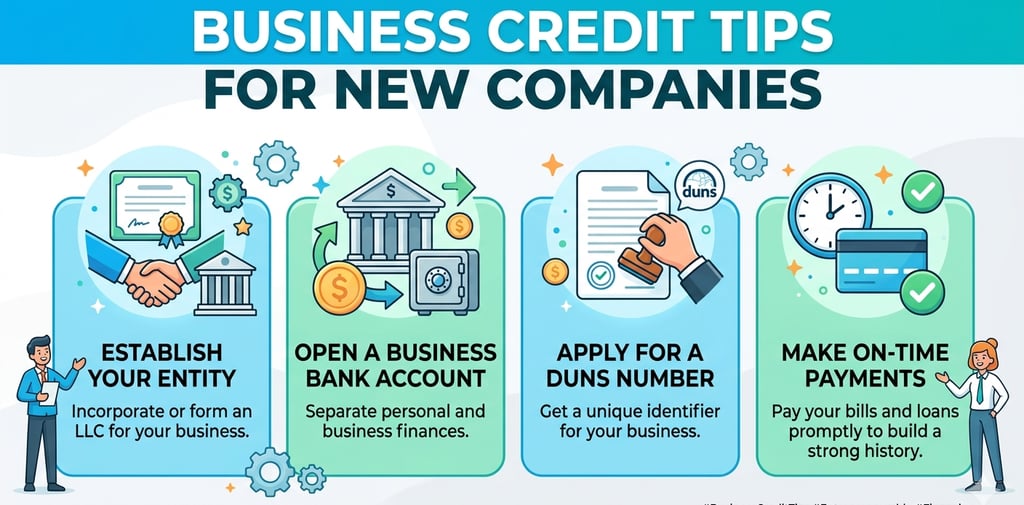
Form an LLC or Corporation. Sole proprietorships are personal — not separate legal entities. Lenders see them as you, not a business.
Get an EIN from the IRS. Your EIN is like a Social Security Number for your business. You use it to open accounts and build credit separate from your personal profile.
Open a dedicated business bank account. This is non-negotiable. A business checking account shows lenders your business has real cash activity.
Get a business phone number and address. When lenders verify your business, they look for a listed phone number and a real address. A PO box does not always work.
If you skip these steps, you may find that your business does not even show up in credit bureau databases — which means no credit profile at all.
Step 2 – Register With Business Credit Bureaus
Most business owners do not know this, but you need to register with the major business credit bureaus:
Dun & Bradstreet – Get a D-U-N-S Number (it is free). This activates your Paydex score, which is one of the most important business credit scores lenders check.
Experian Business – Your business profile here is reviewed by many vendors and lenders.
Equifax Business – Especially important when applying for business loans or lines of credit.
You do not need to do anything complicated here. Just make sure your business name, address, and EIN are accurate and consistent across all records.
Step 3 – Start With Starter Vendor Accounts
This is where most new companies begin actually building credit. Vendor accounts — also called net-30 trade lines — are accounts where a supplier gives you products or services and you pay within 30 days.
When those vendors report your payments to the business credit bureaus, your score starts to build.
Good starter vendors for new companies include:
Uline – Shipping and packaging supplies
Quill – Office products
Grainger – Industrial supplies
Crown Office Supplies – Easy to get approved with no prior credit
Buy small amounts. Pay on time. Over 90 to 180 days, your credit profile starts to look legitimate to lenders.
Step 4 – Apply for a Business Credit Card
Once you have 3 to 5 vendor trade lines reporting, you can apply for a business credit card. Start with cards that are easier to get approved for — many are designed for businesses with limited history.
Use your business credit card for regular expenses. Keep utilization (the percentage of your credit limit you are using) below 30%. Pay on time every month.
This builds your credit faster than almost anything else.
Step 5 – Monitor Your Business Credit Profile
Check your business credit reports regularly. Errors are more common than people think. A wrong address, wrong EIN, or missing payment can hurt your score without you knowing.
Use services like Nav or CreditSafe to track your scores across all three major bureaus.
Business Credit Building Mistakes to Avoid
Many new business owners accidentally damage their credit before it even gets started. These are the most common business credit building mistakes to avoid.
Mistake 1 – Using Your Personal Credit for Everything
If you are running all your business purchases through your personal credit card, you are building personal credit — not business credit. Worse, if something goes wrong, your personal finances are exposed.
Always separate your business and personal finances from day one.
Mistake 2 – Not Being Consistent With Business Information
Your business name, address, and phone number need to be exactly the same everywhere — your LLC registration, IRS records, bank account, credit bureau profiles, and vendor accounts.
Even small differences (like "LLC" vs "L.L.C.") can create mismatches that cause lenders to distrust your profile.
Mistake 3 – Applying for Too Much Too Soon
Applying for loans or credit cards before your business credit profile is built leads to rejections. Every application creates an inquiry on your report. Too many rejections in a short period can make you look desperate or high-risk.
Follow the steps. Build first. Apply second.
Mistake 4 – Not Paying on Time
This sounds obvious, but it is still the number one reason business credit scores stay low. Even one late payment can hurt your Paydex score significantly.
Automate your payments if possible. Paying early is even better — it can actually boost your score with some bureaus.
Mistake 5 – Skipping the LLC Formation
Operating as a sole proprietor with no LLC means your business has no legal separation from you personally. Most lenders will not extend real business credit to an unregistered business.
Form your LLC first. It takes less than a week in most states.
Business Credit Checklist for New Companies
Use this business credit checklist before you apply for any funding. If you cannot check all of these boxes, keep building.
Business Foundation
LLC or Corporation formed in your state
EIN obtained from the IRS
Business bank account opened with real transactions
Business phone number listed (not just your cell)
Business address registered (not a PO box if possible)
Credit Bureau Setup
D-U-N-S Number obtained from Dun & Bradstreet
Business listed on Experian Business
Business listed on Equifax Business
Trade Lines and Vendor Credit
At least 3 vendor accounts open and reporting
Minimum 90 days of payment history on vendor accounts
No late payments on record
Business Credit Cards
At least one business credit card open
Utilization under 30%
Consistent on-time payments
Monitoring
Business credit reports reviewed in last 30 days
No errors or inconsistencies found
All business info matches across all bureaus
Easy Ways to Build Business Credit Score Faster
If you want to speed up the process, here are some easy ways to build your business credit score more quickly.
Pay early, not just on time. With Dun & Bradstreet's Paydex score, paying before the due date can push your score to 80 or higher — the level many lenders look for.
Add more trade lines. The more vendor accounts you have reporting positive payments, the stronger your profile looks. Aim for at least 5 to 7 accounts over your first year.
Use a business credit monitoring service. Services like Nav give you access to your scores and alert you to changes. You cannot fix what you cannot see.
Keep older accounts open. Length of credit history matters in business credit too. Do not close old vendor accounts even if you stop using them.
Apply for credit strategically. Space out your applications. Do not apply for 5 things in the same month.
What Lenders Actually Look for Before Approving Funding
Understanding what lenders want helps you prepare the right way. Most lenders check:
Business credit scores (Paydex, Experian Intelliscore, Equifax Business Credit Score)
Time in business — many lenders want at least 6 to 12 months
Business bank account activity — steady deposits show real revenue
Number of trade lines and payment history
Business structure — LLC or Corporation preferred
When you follow the business credit checklist above, you are building exactly what lenders want to see. This can significantly improve your chances of getting approved for working capital loans, business credit cards, and other funding products.
FAQ: Business Credit Tips for New Companies
Q: How long does it take to build business credit for a new company? Most new companies can build a fundable business credit profile in 6 to 12 months by following the right steps. With consistent effort — especially on vendor trade lines and on-time payments — some owners see results in as little as 90 days.
Q: Can I build business credit without using my personal credit? Yes. Once your LLC and EIN are set up, you can open vendor accounts and business credit cards that report to business credit bureaus only. Many starter vendor accounts do not require a personal credit check.
Q: What credit score do I need to get a business loan? Requirements vary by lender. Many traditional banks want a Paydex score of 75 or higher and a personal credit score of 680+. Alternative lenders may work with businesses that have lower scores. The stronger your business credit, the more options you have.
Q: Is an EIN necessary to build business credit? Yes. Your EIN is how the IRS and credit bureaus identify your business. Without an EIN, you cannot separate your business credit from your personal credit.
Q: What are the easiest trade lines for a new business? Starter vendors like Uline, Quill, and Grainger are well known for approving new businesses. They report to Dun & Bradstreet and help you build your Paydex score quickly.
Q: What is a D-U-N-S Number and do I need one? A D-U-N-S Number is a unique identifier issued by Dun & Bradstreet for your business. It is free to get and activates your Paydex score. You absolutely need one if you are serious about building business credit.
Final Thoughts
Building business credit as a new company is not complicated. But it does require the right steps in the right order.
Set up your business properly. Get your EIN. Open a business bank account. Start with vendor trade lines. Pay on time. Then grow from there.
Most owners who struggle with funding are not failing because of their business idea. They are failing because their credit foundation is not ready. Fix the foundation first, and the funding options will follow.
If you want guidance building your business credit the right way — from setting up your LLC to getting approved for funding — Altopex.com is here to help. We work with US small business owners at every stage and can walk you through the entire process step by step.