
Business Credit Score Improvement Guide
Learn how to improve your business credit score fast with proven steps. Build strong EIN credit, get better funding access, and grow your business.
BUSINESS CREDIT
Russel
6/9/20268 min read

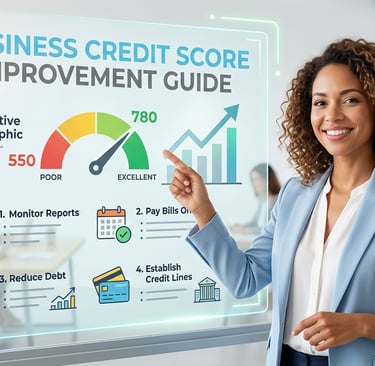
Most small business owners apply for funding and get rejected. Not because their business is bad. Because their business credit score is too low — or doesn't even exist yet.
Lenders look at your business credit before they approve anything. A strong score can get you better loan terms, higher credit limits, and faster approvals. A weak score — or no score — closes doors before you even get a chance to explain yourself.
This business credit score improvement guide walks you through exactly what you need to do. Step by step. No complicated finance talk. Just a clear, practical plan that works.
What Is a Business Credit Score and Why Does It Matter?
A business credit score is a number that shows lenders how financially reliable your business is. It works like a personal credit score, but it's tied to your business — not you personally.
The most common business credit scoring systems are:
Dun & Bradstreet PAYDEX — scores from 0 to 100
Experian Business — scores from 0 to 100
Equifax Business — uses multiple scoring models
When you apply for a business loan, a business credit card, or a line of credit, lenders pull these scores. A score above 75 on PAYDEX is generally considered good. Below 50, you're in risky territory.
Here's the key thing many business owners miss: your business credit score is completely separate from your personal credit score. This means you can build strong business credit even if your personal credit isn't perfect.
Why Most Small Businesses Have Poor Credit Scores
Before you fix something, you need to understand why it's broken.
There are a few common reasons small businesses have low or nonexistent credit scores:
1. No business credit file at all If you just started your LLC or haven't set up vendor accounts yet, the credit bureaus may have nothing on file. No history means no score. Lenders can't approve what they can't evaluate.
2. No separation between personal and business finances Using your personal bank account or personal credit cards for business expenses doesn't build business credit. It only affects your personal score.
3. Paying vendors late Late payments are one of the fastest ways to damage a business credit score. Even one or two late payments can pull your PAYDEX score down significantly.
4. Low credit utilization awareness Credit utilization is how much of your available credit you're using. For example, if you have a $10,000 business credit limit and you're using $9,500, your utilization rate is very high — and that hurts your score. Keeping utilization below 30% is a solid rule to follow.
5. Not reporting vendor accounts to credit bureaus Not all vendors report to business credit bureaus automatically. If they don't report, the account doesn't help your score.
The Business Credit Building Timeline Guide
One of the most common questions is: how long does this take?
Here's a realistic business credit building timeline guide based on how the system actually works:
Month 1–2: Foundation Setup Get your business legally and financially structured. This is the non-negotiable groundwork.
Month 3–4: Open Starter Vendor Accounts Start with net-30 vendor accounts. These are trade lines — business accounts where you buy now and pay within 30 days. When vendors report on-time payments to Dun & Bradstreet or Experian Business, your score starts building.
Month 5–6: Apply for a Business Credit Card With 3–5 trade lines reporting, you'll be in a much stronger position to qualify for a starter business credit card.
Month 7–12: Build a Track Record Keep paying on time. Keep utilization low. Add more accounts as your score grows.
Month 12+: Access Better Funding By the 12-month mark, many business owners are in a position to qualify for working capital loans, revolving credit lines, and business credit cards with higher limits.
The process is steady — not overnight. But if you follow the right steps, you can make meaningful business credit score improvement happen faster than most people think.
How to Increase Business Credit Fast: 7 Proven Steps
These are not generic tips. These are the specific actions that actually move your score.
Step 1: Register Your Business and Get an EIN
Your EIN — Employer Identification Number — is your business's tax ID. It's issued by the IRS and it's completely free to get.
Your EIN is what ties your business credit activity to your business — not to you personally. Without it, you can't open most business accounts, and you can't properly build EIN credit.
If you haven't done this yet, go to IRS.gov and apply. It takes about 10 minutes.
Step 2: Set Up a Dun & Bradstreet Profile (DUNS Number)
Dun & Bradstreet is the largest business credit bureau in the world. Your DUNS number is how they track your business credit file.
Go to Dun & Bradstreet's website and claim or create your business profile. This is free. Once your file exists, vendor payments can start building your score.
Step 3: Open Net-30 Vendor Accounts
Net-30 trade lines are the fastest way to start building business credit from scratch. These accounts let you purchase products or services and pay within 30 days.
Many suppliers and vendors offer these accounts to new businesses with no credit history required. When you pay on time and those payments get reported to credit bureaus, your score starts building.
Look for vendors who specifically report to Dun & Bradstreet, Experian Business, or Equifax Business. Not all do. Choose ones that do.
Some vendor categories that commonly offer net-30 accounts include office supplies, shipping companies, and business software providers.
Step 4: Open a Dedicated Business Bank Account
A business bank account is not just about organization. It's about fundability — meaning your ability to qualify for funding.
Lenders want to see that your business operates like a real business. A business bank account under your business name and EIN is one of the first things they verify.
Keep your business income and expenses completely separate from personal finances. This protects you legally and helps you build a cleaner credit profile.
Step 5: Pay Everything Early or On Time
This is the single most powerful thing you can do for your business credit score.
Late payments can drop your PAYDEX score significantly — even one missed payment can take it from 80 down to 50 or lower. On the flip side, consistent early payments are what push a PAYDEX score toward 80 or higher.
Set reminders. Automate payments when possible. Make on-time payment your non-negotiable standard.
Step 6: Monitor Your Business Credit Reports Regularly
You can't improve what you don't track.
Check your business credit reports on Dun & Bradstreet, Experian Business, and Equifax Business regularly. Look for:
Errors or inaccuracies
Accounts that aren't reporting
Negative marks from late payments
Outdated information
Disputing errors is important. Even small inaccuracies can impact your score and your ability to get approved for funding.
Step 7: Add More Trade Lines Over Time
One or two vendor accounts is a start. But lenders want to see depth — multiple accounts, all reporting positively.
As your score improves, add more vendor accounts, apply for business credit cards, and eventually move toward business lines of credit. Each positive account adds to your credit history and strengthens your score.
Quick Business Credit Improvement Methods That Actually Work
If you're looking for quick business credit improvement methods, here's what actually moves the needle fastest:
Fix errors on your credit report immediately. An incorrect late payment or wrong business information can be disputed and corrected relatively quickly.
Get 3 trade lines reporting within 60 days. Most starter vendor accounts are easy to qualify for. Three reporting accounts can establish a baseline PAYDEX score within 30–60 days of first payment.
Keep your credit utilization under 30%. This alone can meaningfully improve your score if it's currently high.
Add authorized trade line accounts. Some credit-building services offer to add your business to existing accounts with good payment history. This can accelerate the process.
None of these are magic. But combined, they create real momentum.
Business Credit vs. Personal Credit: What's the Real Difference?
This question comes up a lot. Here's the direct answer:
Personal credit uses your Social Security Number (SSN) and follows you as an individual. Business credit uses your EIN and follows your business entity.
The major difference in building them:
FactorPersonal CreditBusiness CreditTied toSSNEIN / Business NameMain bureausEquifax, Experian, TransUnionD&B, Experian Biz, Equifax BizStarting pointYour personal historySeparate from day oneFunding impactPersonal loan approvalsBusiness loan & credit approvals
Building strong business credit means your business can eventually qualify for funding on its own — without you personally guaranteeing every loan. That's real financial separation. And it protects you personally if the business ever faces financial difficulty.
What Lenders Look for When Reviewing Your Business Credit
When a lender pulls your business credit file, they're looking at more than just the score number. Here's what matters to them:
Payment history — the most important factor. Consistent on-time payments show reliability.
Credit utilization rate — high utilization signals financial stress.
Account age — older accounts with good payment history carry more weight.
Number of active accounts — multiple positive trade lines show the business is financially active and responsible.
Public records — liens, judgments, or bankruptcies can severely impact approval chances.
Lenders want to see a business that manages credit responsibly. Give them clear evidence of that, and your approval chances improve significantly.
Common Mistakes That Slow Down Business Credit Building
Avoid these. They're the reason many business owners stay stuck:
Mixing personal and business finances. Every personal purchase on a business account, or business expense on a personal card, muddles your financial profile.
Applying for too many accounts at once. Multiple hard inquiries in a short window can flag your profile as high-risk.
Ignoring your business credit reports. Errors sit there for years if you don't look.
Working with vendors who don't report. If your vendor doesn't report to D&B or Experian, those payments aren't helping your score at all.
Giving up too early. Business credit takes time to build. The first 90 days feel slow. Months 6–12 is where the real progress shows.
FAQ: Business Credit Score Improvement
How long does it take to build business credit from scratch? You can establish a baseline PAYDEX score within 30–60 days of getting your first trade line to report. Building a strong, fundable score typically takes 6–12 months with consistent effort.
Can I build business credit without using my SSN? Yes. Once your business is properly set up with an EIN, business credit can be built using your EIN only. Many trade lines and business credit cards can be obtained without an SSN once you have an established business credit profile.
What credit score do I need to get a business loan? It depends on the lender. For traditional bank loans, a PAYDEX score of 75 or higher is generally preferred. Alternative lenders may approve businesses with lower scores, but often at higher interest rates. The higher your score, the better your terms.
How do I check my business credit score? You can check your business credit score through Dun & Bradstreet, Experian Business, and Equifax Business. Some services offer free basic reports; detailed reports typically require a subscription.
Does opening a business credit card help my business credit score? Yes — if the card reports to business credit bureaus. Not all business credit cards do. Before applying, confirm the card reports to at least one major business bureau.
Can a new LLC build business credit? Absolutely. A new LLC can start building business credit right away by getting a DUNS number, opening vendor accounts, and maintaining a dedicated business bank account. Age of business matters, but it doesn't stop you from starting.
What is a PAYDEX score and is it the same as a business credit score? PAYDEX is Dun & Bradstreet's specific business credit scoring model. A score of 80+ means you typically pay on time. It's one of several business credit scores — Experian Business and Equifax Business have their own models too. Lenders may check one or all of them.
Conclusion: Start Building the Right Way
Your business credit score doesn't improve by accident. It improves because you take deliberate steps — setting up your EIN, opening the right accounts, paying on time, and watching your profile grow.
The good news is that this is completely within your control. You don't need perfect personal credit. You don't need years of business history. You just need a clear plan and the discipline to follow it.
A strong business credit profile opens doors to better funding, higher credit limits, and more financial flexibility. That means more options to grow your business on your terms.
If you want help building your business credit the right way and getting access to real funding, Altopex.com can guide you step by step. Whether you're just starting out or trying to improve what you already have, we can help you move forward faster.