
How Long Does It Take to Build Business Credit? (2026 Guide)
Find out exactly how long it takes to build business credit, what affects your timeline, and the fastest steps to get funded in 2026.
BUSINESS CREDIT
Russel
5/23/20268 min read
How Long Does It Take to Build Business Credit? (Complete 2026 Timeline Guide)
Most small business owners ask this question after their first loan rejection.
"How long do I actually need to wait before I can get real business funding?"
The honest answer is — it depends. But with the right steps, you can start seeing results in as little as 30 to 90 days. And within 6 to 12 months, many business owners have a solid business credit profile that lenders actually take seriously.
This guide breaks down the full business credit building timeline, what slows most people down, and the fastest legal path to fundability in 2026.
What Is Business Credit and Why Does the Timeline Matter?
Business credit is your company's financial reputation — separate from your personal credit score.
When lenders, suppliers, and vendors look at your business, they pull your business credit report. That report shows how your business handles payments, how long it has been operating, and whether it qualifies for funding.
The timeline matters because most lenders want to see an established business credit profile before they approve loans or credit lines. Without it, you either get rejected or stuck using your personal SSN (Social Security Number) to guarantee everything.
Building business credit on your EIN (Employer Identification Number) — that's your business's tax ID — is the goal. It protects your personal finances and opens the door to higher credit limits and better funding options.
The Business Credit Building Timeline: A Realistic Breakdown
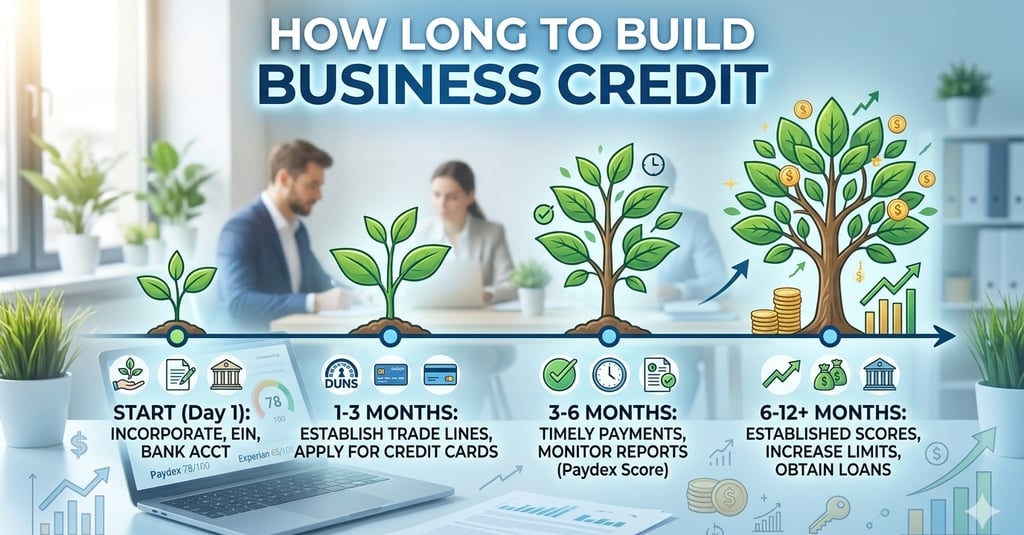
Here is a stage-by-stage look at how long each phase actually takes:
Phase 1: Business Setup (Days 1–30)
Before any credit building starts, your business needs to be set up correctly. This is something most people skip — and it's exactly why they struggle later.
During this phase you need to:
Register your business as an LLC or Corporation (not a sole proprietor)
Get your EIN from the IRS (free and fast — usually same day online)
Open a dedicated business bank account
Set up a business address (a real address, not just a P.O. box)
Get a business phone number listed in directory assistance
Build a basic professional website
These steps are not optional. Lenders and credit bureaus use this information to verify your business is real and legitimate. If any of it is missing, your credit applications can get rejected before they even start.
This phase typically takes 2 to 4 weeks if you move quickly.
Phase 2: Starter Vendor Accounts (Days 30–90)
This is where actual business credit building begins.
Starter vendors — also called net-30 vendor accounts — give your business a small credit line to buy supplies or services. You pay within 30 days, and they report that payment history to business credit bureaus like Dun & Bradstreet, Experian Business, and Equifax Business.
Think of this like your first credit card when you were young. You start small to prove you can pay on time.
Good examples of starter vendors include office supply companies, shipping suppliers, and business product companies that report to credit bureaus. The key is to find vendors who:
Do not require an existing business credit score to approve you
Report to at least one major business credit bureau
Extend real net-30 terms
Getting approved with 3 to 5 starter vendors and paying them on time will create your first business credit profile. Most business credit bureaus require at least 2 to 3 accounts reporting before they generate a score for your company.
This phase takes about 30 to 90 days to get your first score.
Phase 3: Building Your Credit Score (Months 3–6)
Once you have a few vendor accounts reporting, your Paydex score (Dun & Bradstreet's scoring system) or Experian Intelliscore starts to build.
Here is what affects your score at this stage:
Payment history — Pay early or on time, every time. Late payments hurt your score fast and take months to recover from.
Number of accounts — The more positive accounts reporting, the stronger your profile.
Credit utilization — This means how much of your available credit you are using. Try to stay below 30%. For example, if a vendor gives you a $500 limit, don't charge more than $150 at a time.
Account age — Older accounts look more stable to lenders. This is why you should start early, even if you are not planning to borrow right away.
By month 3 to 6, many businesses have enough positive history to qualify for net-30 accounts with larger suppliers and even some entry-level business credit cards that don't require a personal guarantee.
Phase 4: Business Credit Cards and Store Cards (Months 4–8)
Once your foundation is solid, you can move up to business credit cards and retail store accounts.
These accounts typically offer higher limits than vendor accounts and report to multiple bureaus at once. Getting approved here is a big milestone in your business credit building journey.
At this stage, you can start targeting:
Business store cards (like Uline, Staples, or similar)
Entry-level business credit cards that use business credit instead of personal
Fleet cards (for businesses using vehicles or equipment)
These cards can give you $500 to $5,000 in credit depending on your profile strength. Using them responsibly and paying on time pushes your score higher every month.
Phase 5: Bank Loans and Revolving Credit (Months 6–18)
This is the phase most business owners are really aiming for.
Revolving credit means a credit line you can draw from repeatedly — like a business line of credit. It is one of the most flexible funding tools for small businesses because you borrow what you need and pay it back on your own schedule.
To qualify for revolving credit or working capital loans from banks and SBA lenders, most lenders want to see:
At least 6 to 12 months of business history
A business credit profile with multiple positive accounts
A business bank account with consistent activity
Some revenue coming into the business
At this stage, a well-built business credit profile can help you access $10,000 to $150,000+ in funding depending on your business revenue and financial history.
What Slows Down Your Business Credit Building?
A lot of business owners take 2 to 3 years to build solid credit when it could have taken 6 to 12 months. Here is why:
Starting with a sole proprietorship. Sole proprietors cannot build true EIN-based business credit. The business and the owner are legally the same entity. You need an LLC or Corporation.
No business bank account. Without a business account, you look like a hobby, not a real business. Lenders check for this.
Using wrong vendor accounts. Not all vendor accounts report to business credit bureaus. If they don't report, they don't help your score. Always verify before opening an account.
Late payments. One late payment can drop your Paydex score significantly. Pay early whenever you can.
Skipping Dun & Bradstreet setup. You need a DUNS number (a free business identifier from D&B) to build credit with Dun & Bradstreet, which is the most widely used business credit bureau by lenders. You can register for one for free at their website.
Applying for too much credit too fast. Multiple hard inquiries in a short time can hurt your profile. Be strategic about when and what you apply for.
How to Fast Track Business Credit Building in 2026
If you want to speed things up, here is the most efficient path:
Step 1: Set up your business correctly (LLC, EIN, business address, phone, bank account) — Week 1 to 2.
Step 2: Register for a DUNS number with Dun & Bradstreet — Week 2 (takes up to 30 days to activate).
Step 3: Open 3 to 5 starter net-30 vendor accounts that report to credit bureaus — Month 1 to 2.
Step 4: Use those accounts for small purchases and pay within the net-30 terms — Month 2 to 3.
Step 5: Monitor your business credit reports at D&B, Experian Business, and Equifax Business — Month 3+.
Step 6: Apply for business store cards and retail credit as your profile grows — Month 4 to 6.
Step 7: Target business credit cards and small credit lines — Month 6 to 9.
Step 8: Apply for working capital loans, revolving credit, or SBA funding — Month 9 to 18.
This is not a shortcut — it is just doing the right things in the right order without wasting time.
Business Credit Basics Every Small Business Owner Should Know
If you are new to this, here are the fundamentals:
Business credit is separate from personal credit. Building business credit protects your personal FICO score and personal assets.
There are three main business credit bureaus. Dun & Bradstreet, Experian Business, and Equifax Business each have their own scoring systems. Some lenders check all three.
Your Paydex score goes from 0 to 100. A score of 80 or above means you pay on time. Above 80 means you pay early. Most lenders want to see 75 or higher.
Not all lenders report to business bureaus. Some loans you take out won't help your business credit at all. Choosing lenders and vendors that report is important.
Business credit can be built even with bad personal credit. This is one of the biggest advantages. If your personal credit took a hit in the past, business credit is a fresh start.
How Long Does It Really Take? A Realistic Summary
Here is a quick reference for the full business credit building timeline:
StageWhat HappensTimelineBusiness SetupLLC, EIN, bank account, address1–4 weeksFirst Vendor AccountsNet-30 accounts reportingMonth 1–2First Business Credit ScoreD&B Paydex, Experian scoreMonth 2–3Business Store CardsRetail and fleet accountsMonth 4–6Business Credit CardsUnsecured business cardsMonth 6–9Revolving Credit / LoansCredit lines, working capitalMonth 9–18
If you stay consistent and follow the right steps, 6 to 12 months is a realistic timeline for most small business owners to build a strong fundable profile.
FAQs: Business Credit Building Timeline
How long does it take to build business credit from scratch? Most businesses can establish a basic business credit profile in 30 to 90 days with the right vendor accounts. A strong fundable profile typically takes 6 to 12 months of consistent effort.
Can I build business credit without using my personal SSN? Yes. Once your business is properly set up as an LLC or Corporation with an EIN, you can open vendor accounts and some credit products using your EIN only. This is the goal of building separate business credit.
What is the fastest way to build business credit? The fastest way is to set up your business correctly, get a DUNS number early, open 3 to 5 net-30 vendor accounts that report to bureaus, and pay everything on time or early. Consistency is faster than any shortcut.
Does a business bank account help build credit? A business bank account is not a credit account, so it doesn't directly build your credit score. But lenders and credit bureaus look for a business bank account as proof your business is real and financially active. It is required for most loan applications.
What credit score do I need to get a business loan? It depends on the lender. For traditional bank loans, a Paydex score of 75+ and 12 months of business history are commonly required. Some online lenders and alternative funding options have lower requirements but may charge higher rates.
Can I build business credit with bad personal credit? Yes. Business credit is built on your EIN and company history, not your personal score. That said, some lenders still do a soft check on personal credit, especially for newer businesses. But building business credit is one of the best ways to reduce dependence on your personal FICO score over time.
Conclusion: Start Building Today, Fund Your Business Tomorrow
Building business credit is not complicated. But it does take time, the right steps, and consistency.
The business owners who struggle are usually the ones who start late, skip the setup steps, or use the wrong accounts. The ones who succeed are the ones who treat business credit like an investment — building it steadily every month until funding opportunities start opening up.
You do not need perfect personal credit. You do not need years of business history to start. You just need to start correctly.
If you want help building your business credit the right way and accessing real funding options, Altopex.com can guide you through every step — from setup to funding approval.